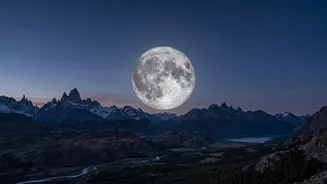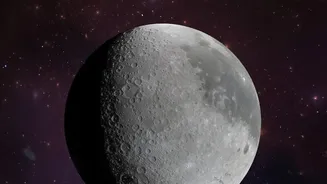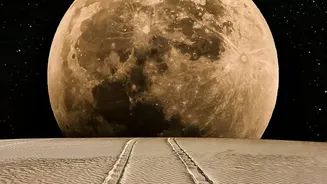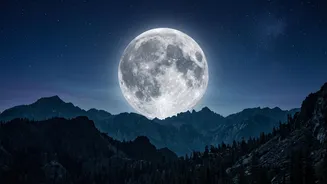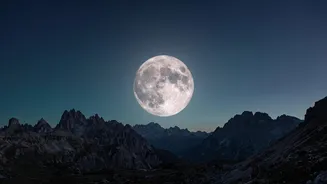


You’ve seen it: a colossal, orange moon balanced on the horizon, looking close enough to touch. Then, hours later, it's a small, white disc high in the sky. The most common explanation is a myth, and the truth is all in your head.
The Myth: The Atmosphere is a Magnifying Glass
The story goes that when
the moon is low, we see it through a much thicker slice of Earth’s atmosphere. This thicker air, people assume, acts like a lens, bending light and magnifying the moon into that stunning, oversized orb. It’s an idea that dates back to ancient times, with Greek philosophers like Aristotle suggesting atmospheric effects were at play. It feels intuitive. After all, the atmosphere does affect what we see—it’s why the setting sun turns red and why the horizon moon often glows with a warm, orange hue. This color change is real, caused by the scattering of shorter, bluer wavelengths of light. So, it's a small leap to assume the atmosphere is also responsible for the size change. But while the air does bend light, it doesn't do what most people think it does.
The Reality: Refraction Actually Shrinks the View
Here's where the myth crumbles under basic physics. Atmospheric refraction does change the moon’s appearance, but not by making it bigger. In fact, it has the opposite effect. The light from the bottom edge of the moon travels through slightly more atmosphere than the light from the top edge. This difference in refraction causes the moon to look slightly flattened or squashed vertically when it’s near the horizon. If you take a photograph of the moon on the horizon and another when it's overhead (with the same camera settings), you’ll find its width is identical in both pictures. If anything, the horizon moon is physically a tiny bit smaller in the sky because it's actually farther away from you—by about one Earth radius—than when it's directly overhead. This photographic evidence proves the massive size difference isn't a physical phenomenon but an optical illusion.
The Real Culprit: Your Brain's Deceptive Logic
The Moon Illusion, as it's officially known, is a powerful trick of perception. The most widely accepted explanation is the 'apparent distance hypothesis'. Your brain has spent a lifetime learning to judge the size and distance of objects using contextual clues. When the moon is high in the sky, it floats in a vast, empty expanse. With no points of reference, your brain perceives it as being relatively close but small. However, when the moon is on the horizon, it's surrounded by familiar objects: trees, buildings, and mountains. Your brain sees these objects and knows they are far away. Because the moon is sitting behind them, it must be even farther. Here's the crucial step: when your brain perceives two things that take up the same amount of space in your field of vision, it concludes that the one it thinks is farther away must be physically larger. Your brain inflates the size of the horizon moon to make sense of the scene.
An Everyday Example: The Ponzo Illusion
To understand how your brain makes this error, consider the classic Ponzo illusion. Imagine a drawing of railroad tracks converging toward a vanishing point on the horizon. If you draw two identical horizontal lines across the tracks—one near the bottom and one farther up where the tracks are closer together—the upper line will look significantly longer. Your brain uses the converging lines as a depth cue, interpreting the upper part of the image as being farther away. It then scales up the size of the line in that 'distant' location to compensate. The Moon Illusion works on the same principle. The landscape provides the converging lines of perspective, and the moon is any object your brain resizes based on its perceived distance. The presence of foreground objects is so powerful that even pilots and sailors, who see the moon over a featureless ocean horizon, still report the illusion.