



The Universe in the Dark
Imagine a time before stars and galaxies, a period stretching into the hundreds of millions of years after the Big Bang. The universe was not empty, but it was dark. It was filled with a vast, opaque cloud of neutral hydrogen gas, which acted like a thick
fog, preventing light from travelling freely across space. This period is often called the cosmic “dark ages.” After the initial fireball of the Big Bang cooled, protons and electrons combined to form these neutral atoms, and in doing so, they essentially drew a curtain across the cosmos. Any light that might have existed would have been scattered and absorbed, unable to journey far. For an observer, it would have been a profoundly dark and uniform existence, waiting for the lights to come on.
The First Lights Turn On
The end of the dark ages began with the birth of the very first stars and galaxies. These weren't the grand spiral galaxies we see today, but likely small, intensely hot, and compact collections of stars. The powerful ultraviolet light these first celestial objects produced was energetic enough to start changing the universe around them. This light began to ionize the neutral hydrogen, a process that strips electrons from their atoms. This re-ionization, as it's called, didn't happen all at once. Instead, these early galaxies created bubbles of transparency around them. Inside these bubbles, light could travel freely. Over hundreds of millions of years, these individual bubbles grew and eventually merged, until the entire cosmic fog was burned away, leaving the universe transparent.
The Culprits Are Finally Identified
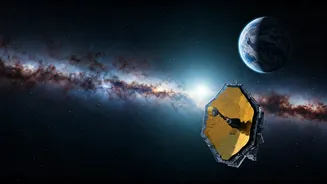
For years, a major question in cosmology was what exactly drove this monumental transformation. Were it massive galaxies, supermassive black holes, or something else? Recent observations, particularly from the James Webb Space Telescope (JWST), are providing stunning answers. Evidence now strongly points to a surprising source: tiny, faint dwarf galaxies. Recent studies, using the JWST to peer back over 13 billion years, have identified dozens of these small, early galaxies that were punching well above their weight. Though thousands of times less massive than our own Milky Way, they were incredibly efficient at producing the high-energy ultraviolet light needed to clear the fog. These findings suggest that the collective effort of countless small galaxies, not a few large ones, was responsible for one of the most significant changes in cosmic history.
A Cosmic Surprise Challenges Everything
Just as this picture was becoming clear, other new discoveries have thrown a wrench in the works. In a startling finding, astronomers detected a galaxy, named JADES-GS-z13-1, that existed just 330 million years after the Big Bang. According to established theories, the cosmic fog should have been far too thick at this early stage for any light from the galaxy to be visible. Yet, Webb detected a clear signal of hydrogen light, which should have been completely blocked. This unexpected result has caught astronomers by surprise. It suggests that this galaxy had somehow cleared a path for its light to escape far earlier than models predicted. This discovery challenges our understanding of how quickly the first galaxies could influence their environment and forces scientists to reconsider the timeline of this cosmic dawn.
Why This Cosmic Weather Report Matters
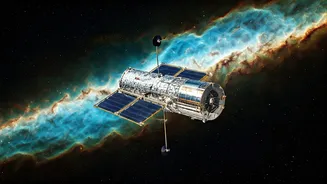
Understanding when and how the cosmic fog cleared is about much more than ancient history. It's fundamental to understanding our own origins. This transition from a dark, neutral universe to a transparent, ionized one set the stage for everything that followed. It allowed light from galaxies to travel across the cosmos, enabling the large-scale structures like galaxy clusters we see today to form and interact. By pinpointing when this change happened and what caused it, scientists can refine their models of early star and galaxy formation. Every new discovery from telescopes like the JWST and Hubble provides a clearer snapshot of this pivotal era, allowing us to piece together the story of how the universe became the complex, star-filled place it is today. It’s a direct look at the universe switching on its lights for the first time.