
An Inhospitable World of Mysteries
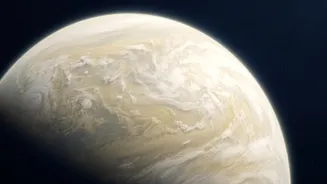
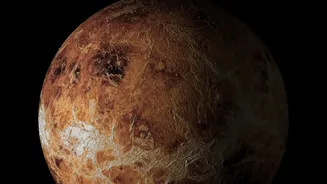
Venus is often called Earth's sister planet due to their similar size and mass, but the similarities end there. It is the hottest planet in our solar system, with surface temperatures soaring to a scorching 460°C, hot enough to melt lead. Its atmospheric
pressure is over 90 times that of Earth's, equivalent to being nearly a kilometre deep in the ocean. The planet is shrouded in thick, toxic clouds of sulfuric acid that make direct observation of its surface impossible with conventional cameras. Understanding why this world, once potentially habitable, evolved so differently from our own is one of the biggest questions in planetary science and a primary driver of the Shukrayaan mission.
Peering Through the Veil: The Radar Eyes
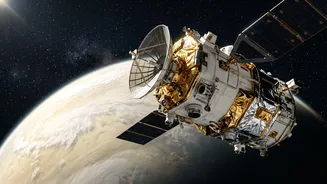
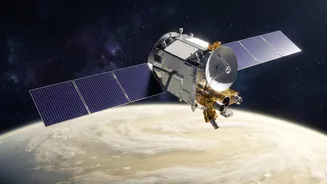
To understand Venus, one must first see it. Shukrayaan's flagship instrument is a high-resolution Synthetic Aperture Radar (SAR), which can pierce through the dense cloud cover. Unlike a normal camera, radar actively sends out radio waves and analyses the echoes that bounce back, creating a detailed topographical map of the surface, day or night, regardless of weather. Shukrayaan's SAR is designed to be significantly more powerful than the one on NASA's Magellan mission in the 1990s, offering up to four times better resolution. This will allow scientists to spot volcanic features, lava flows, and other geological structures with unprecedented clarity, hunting for evidence of ongoing volcanic activity that shapes the planet's chemistry.
A First for Venus: Digging Deeper
Shukrayaan is also set to make history by carrying the first-ever Ground-Penetrating Radar (GPR) to Venus. While the SAR maps the surface, the GPR will probe what lies beneath, sending signals that can penetrate several metres underground. This will provide the first-ever look at the planet's shallow subsurface stratigraphy—the layering of rock and soil. By studying these layers, scientists hope to unravel Venus's geological history, understand its crust formation, and search for buried features that hold clues to its past climate and water presence. No mission has ever studied the Venusian subsurface before, making this a truly pioneering investigation.
Sniffing the Atmosphere for Clues
A key objective of Shukrayaan is to analyse the composition and dynamics of the hostile Venusian atmosphere. To do this, it carries a suite of spectrometers and analysers. One of the most anticipated is the Venus InfraRed Atmospheric gases Linker (VIRAL), a collaborative instrument with Russia and France. VIRAL will study the chemical makeup of the atmosphere, with a particular focus on searching for trace gases like phosphine. The contested detection of phosphine in Venus's clouds in 2020 sparked intense debate, as on Earth, this gas is associated with biological processes. VIRAL could provide a more definitive answer. Other instruments will monitor cloud movements, map thermal emissions, and even watch for lightning.
The Solar Wind Connection
Unlike Earth, Venus has a very weak magnetic field, leaving its upper atmosphere exposed to the solar wind—a constant stream of charged particles from the Sun. Understanding this interaction is crucial for figuring out how Venus lost its water and evolved into its current state. The Shukrayaan orbiter will carry instruments developed in collaboration with Sweden and Germany to study this very process. The Swedish-led Venusian Neutrals Analyser (VNA) will study how particles from the solar wind interact with the atmosphere, providing vital data on atmospheric escape and evolution.