




In a landmark achievement for space science, India's Aditya-L1 and the European Space Agency's Proba-3 missions are working in tandem, providing an unprecedented view of the Sun and yielding crucial new data on its violent solar outbursts.
A Partnership Across the Stars
For the first
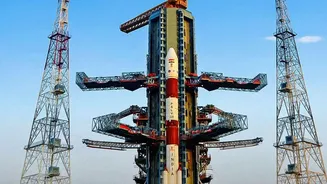
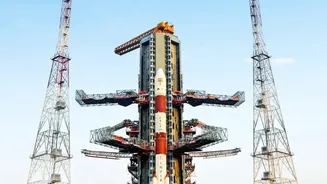
time, scientists have combined observations from India's maiden solar mission, Aditya-L1, with data from ESA's precision Proba-3 spacecraft. Researchers at Bengaluru's Indian Institute of Astrophysics (IIA) are leading the analysis of joint observations captured by the two missions, which were both launched with the help of ISRO's reliable PSLV rockets. This collaboration allows for a much deeper understanding of coronal mass ejections (CMEs) — massive eruptions of plasma and magnetic fields from the Sun's atmosphere — than either spacecraft could achieve alone.
Two Missions, One Sun
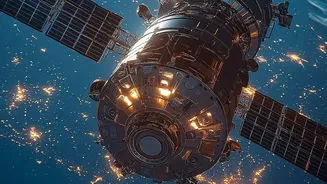
The two missions offer unique, complementary views. Aditya-L1, stationed at the first Lagrange point (L1) 1.5 million kilometres from Earth, provides an uninterrupted view of the Sun. Its key instrument for this research, the Visible Emission Line Coronagraph (VELC), is an advanced coronagraph that uses spectroscopy to analyse the temperature, velocity, and density of the solar corona. Meanwhile, ESA's Proba-3 is a revolutionary mission in itself. It consists of two satellites flying in precise formation, 150 metres apart, to create a perfect artificial solar eclipse. This allows its ASPIICS coronagraph to capture incredibly detailed images of the Sun's faint, inner corona, a region notoriously difficult to observe.
Decoding Coronal Mass Ejections
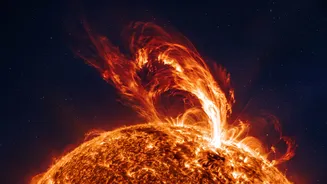
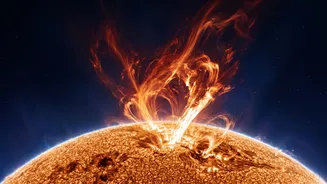
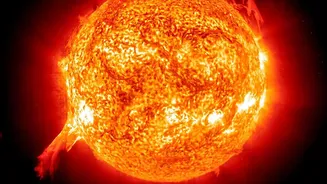
CMEs are among the most powerful events in our solar system. They are born from the twisting and snapping of the Sun's magnetic field lines, which explosively release enormous clouds of charged particles into space at speeds ranging from under 200 to over 2,000 kilometres per second. While the Sun ejects CMEs frequently, those directed towards Earth can have significant consequences. They can trigger intense geomagnetic storms that disrupt our planet's magnetic field, posing a risk to satellites in orbit, power grids on the ground, and telecommunication systems that we rely on daily. Understanding their formation is key to improving space weather forecasting.
A Groundbreaking Glimpse of Early Changes
Observing the birth of a CME has always been challenging because these events are faint in their initial stages and happen very close to the Sun's blindingly bright surface. This is where the joint power of Aditya-L1 and Proba-3 becomes critical. By combining VELC's spectroscopic data (measuring plasma properties like temperature and density) with ASPIICS's clear images (defining the shape and motion), scientists can now track the evolution of CMEs right from their inception. Recent joint observations of two separate CMEs revealed crucial early changes, showing how their energy is distributed and how their density evolves differently depending on their speed. For instance, in one slower CME, the thermal (heat) energy grew to become comparable to its kinetic (motion) energy, a detail that was previously hard to pin down. These findings provide the first clear measurements of the mass, density, and energy budget of CMEs in the low corona, filling a critical gap in our understanding.
Why This Matters for India and the World
This research isn't just academic; it has profound practical implications. Better models of CME formation lead to more accurate space weather forecasts. For a nation like India, which is increasingly reliant on space-based technology for communication, navigation, and defense, the ability to predict a solar storm's arrival and intensity is invaluable. It allows satellite operators to put spacecraft into a safe mode and helps power grid managers take protective measures to prevent blackouts. This Indo-European collaboration highlights India's rising capabilities in space science and its role as a key international partner in tackling some of the biggest scientific challenges. The data gathered is helping to build a more complete picture of the Sun's behaviour, which is crucial for protecting our technological infrastructure both on Earth and in space.