




A Cosmic Gathering Explained
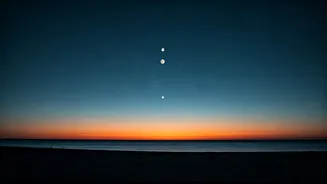
When we say planets are in a “lineup” or an “alignment,” it doesn’t mean they're literally stacked in a straight line out in space. They are still millions of kilometres apart, each on its own vast orbit. What it means is that from our vantage point here
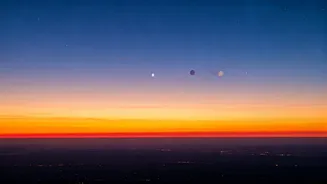
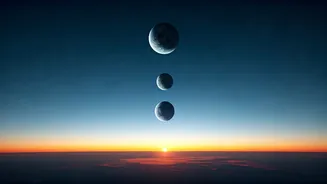
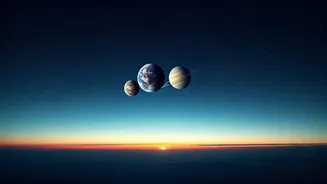
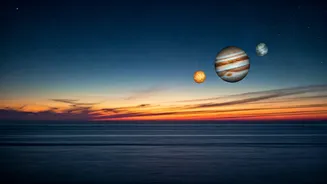
on Earth, they appear close together in a small patch of sky. This is also known as a conjunction. While two-planet conjunctions are fairly common, seeing three bright planets clustered together is a more special occasion. It’s a beautiful display of the solar system’s dynamic, ever-moving nature—a celestial dance where we have the perfect front-row seat.
The Three Planets on Display
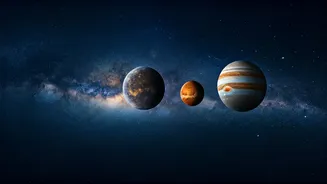
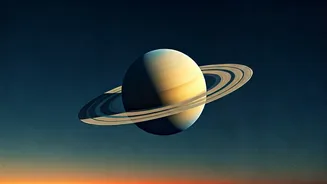
The trio gracing our skies often consists of planets like Mars, Jupiter, and Saturn, each with a distinct personality. Jupiter, the king of planets, will likely be the brightest of the three, shining with a brilliant, steady silver-white light. Saturn, the ringed wonder, will appear slightly dimmer with a calmer, yellowish-white glow. While you can’t see its famous rings with the naked eye, its constant light sets it apart from twinkling stars. Finally, there’s Mars. The Red Planet lives up to its name, casting a distinct reddish-orange light that makes it easy to identify. Seeing these three distinct worlds—a gas giant, a ringed jewel, and a rocky red neighbour—all in the same field of view is a memorable experience.
Your Guide to Time and Direction
The key to catching this planetary parade is timing and location. As the planets will be low on the horizon, an unobstructed view is crucial. For an evening show, look to the west about 45 to 60 minutes after sunset. This is the 'blue hour,' when the sky is dark enough for them to pop out, but before they sink below the horizon. If it's a pre-dawn alignment, you'll be looking to the east about an hour before sunrise. City dwellers should try to find a rooftop, park, or any open space away from tall buildings and bright streetlights. The further you are from light pollution, the more brilliant the view. Give your eyes at least 10 minutes to adjust to the darkness.
How to Spot the Planets
How do you tell if you’re looking at a planet or just a bright star? The simple trick is that planets don't twinkle as much as stars. Stars are so distant their light is a single point, easily disturbed by Earth’s atmosphere, causing the twinkling effect. Planets are closer, appearing as tiny discs, so their light shines with a steadier glow. Once you've found the viewing direction, the brightest object will likely be Jupiter; use it as an anchor point to find the others. Saturn will be nearby with its yellowish hue, and Mars will stand out with its distinctive reddish colour. Stargazing apps on your phone can also be a great help; simply point your phone at the sky to identify everything.
Telescope Optional, Curiosity Required
You don't need any expensive equipment. The beauty of a bright planetary alignment is that it’s completely visible to the naked eye, a sky show open to everyone. However, if you have a pair of binoculars, bring them along! They will dramatically enhance the view. Through binoculars, you might see Jupiter as a distinct orb rather than just a point of light. On a very clear night, you may even glimpse its four largest moons as tiny pinpricks of light flanking the planet. While a telescope would reveal Saturn’s rings or details on Mars, the simple act of seeing these worlds with your own eyes, hanging like jewels in the twilight sky, is the real magic of the moment.