







How to See an Atmosphere from 40 Light-Years Away
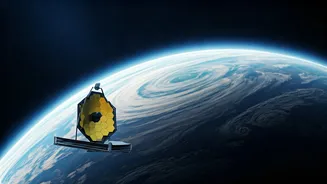
The James Webb Space Telescope (JWST) doesn't have a magic weather vane for other planets. Instead, it uses an ingenious method called transmission spectroscopy. When an exoplanet passes in front of its host star from our perspective, a tiny fraction
of the starlight filters through the planet's atmosphere. Different gas molecules in that atmosphere absorb specific wavelengths, or colours, of light. By capturing the spectrum of light that makes it through, Webb can identify these missing wavelengths, creating a chemical fingerprint of the atmosphere. This allows scientists to determine which gases are present, from carbon dioxide to methane, providing the fundamental building blocks for understanding a planet's climate. The telescope also measures the planet's thermal emission—the heat it gives off—to map temperatures and understand how energy is distributed.
Case Study: The Magma World of 55 Cancri e
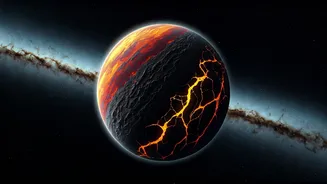
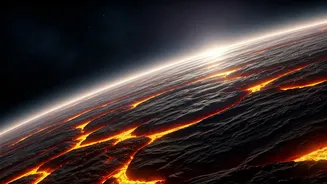
One of the most compelling recent examples is 55 Cancri e, a rocky 'super-Earth' located 41 light-years away. This planet orbits its star so closely that its surface is likely a roiling ocean of molten magma. For a long time, scientists debated whether a planet under such intense heat and radiation could even hold onto an atmosphere. Previous observations were inconclusive, but recent data from Webb provided the best evidence to date that 55 Cancri e does, in fact, have a substantial atmosphere. The key clue came from its temperature. Without an atmosphere to circulate heat, the planet's dayside should be around 2,200 degrees Celsius. However, Webb’s instruments measured a cooler temperature of about 1,500 degrees Celsius. This strongly suggests an atmosphere is transporting energy from the scorching hot dayside to the perpetual nightside.
An Atmosphere Forged in Fire
The atmosphere of 55 Cancri e is likely not the one it was born with. Any primordial atmosphere would have been blasted away long ago by the nearby star. Instead, researchers believe they are seeing a 'secondary atmosphere' that is constantly being replenished from the planet itself. The theory is that gases, likely rich in carbon dioxide or carbon monoxide, are bubbling out of the massive magma ocean. This outgassing from the interior creates a dynamic atmosphere that, while brutally hot and entirely uninhabitable, offers a unique window into planetary processes. It shows that even on the most extreme rocky worlds, atmospheres can exist, sustained by the planet's own geology.
Why Studying Hostile Worlds Matters
While worlds like 55 Cancri e are far too hot for life, studying them is crucial. They provide insights into the early stages of planets like Earth, Venus, and Mars, which are all thought to have had magma oceans in their distant past. By understanding the interactions between a planet's interior, surface, and atmosphere under extreme conditions, scientists can refine their models of planetary evolution. Other Webb observations, like those of TRAPPIST-1c, have shown how a star can strip an atmosphere away, leaving a barren rock. In another recent finding from July 2026, Webb studied a Jupiter-sized planet, WD 1856 b, that survived the death of its star, finding an atmosphere with methane and observing how it settled into a new, close orbit. Each discovery, whether of a thriving atmosphere or a non-existent one, helps scientists piece together the puzzle of what makes a planet habitable.