



The Quest for a Second Earth
For centuries, we have wondered if we are alone in the universe. Today, powerful tools like the James Webb Space Telescope (JWST) are transforming this philosophical question into a scientific investigation. Astronomers are scanning the cosmos for exoplanets—planets
orbiting other stars—that might have the right conditions for life. The primary target is a world in the 'habitable zone,' a region around a star where temperatures could allow liquid water to exist on a planet’s surface. But finding a planet in this 'Goldilocks' region is just the first step. The real challenge is finding proof of life itself. Scientists hunt for biosignatures: gases in a planet's atmosphere that are likely produced by living organisms. One of the most promising, and complicated, biosignatures is methane.
Methane: A Complicated Clue
On Earth, the vast majority of methane in our atmosphere is produced by life, from microbes in wetlands to the digestive systems of animals. This makes it a tantalizing target for astrobiologists. If we find methane in the atmosphere of a rocky, temperate exoplanet, it could be a monumental discovery. However, there's a major catch: methane can also be produced by non-biological processes. Volcanoes, interactions between water and rock deep underground, and even meteorite impacts can all release methane into an atmosphere. This creates the 'false positive' problem: how can we be sure that the methane we detect is a sign of life and not just a quirk of geology? To solve this puzzle, scientists need a way to distinguish between biological and geological methane. Surprisingly, the answer involves looking at planets where we know for certain there is no life.
Our Cosmic Laboratory: Warm Neptunes
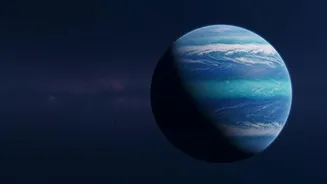
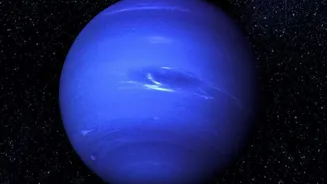
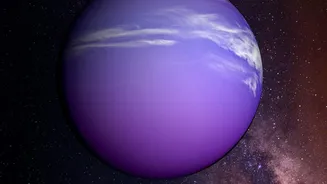
Enter the 'Warm Neptunes'. These are gas giant exoplanets similar in size to Neptune in our own solar system but orbiting extremely close to their parent stars. Planets like WASP-80 b, for example, are scorching hot, with temperatures soaring over 1,000 degrees Fahrenheit, and they complete an orbit in just a few days. They are completely inhospitable to life as we know it. This makes them perfect laboratories. Because life is not a factor, any methane detected in their atmospheres must be the result of geological or chemical processes. By studying these planets, scientists can get a clean, unambiguous look at what non-biological methane signatures look like under extreme conditions. They can build a library of 'false positive' signals.
Decoding the Atmospheric Fingerprint
Using the JWST, astronomers can perform a technique called transmission spectroscopy. When a planet passes in front of its star, a tiny fraction of starlight filters through the planet's atmosphere. The molecules in the atmosphere absorb light at specific wavelengths, leaving a unique chemical 'fingerprint' or 'barcode' in the light that reaches the telescope. By analyzing this barcode, scientists can identify the gases present, such as methane, water vapor, and carbon dioxide. Recent observations of Warm Neptunes like WASP-107b have not only detected methane but also measured its concentration in relation to other gases. These measurements provide crucial data on how methane behaves in a lifeless environment, showing how it is formed, destroyed, and mixed by a planet’s hot interior and intense radiation from its star.
Sharpening the Search for Life
The knowledge gained from studying these uninhabitable worlds is invaluable. By building a detailed understanding of how non-biological processes create methane, scientists are essentially creating a field guide to false positives. When they eventually turn the JWST toward a promising Earth-sized planet in the habitable zone and detect methane, they will have a basis for comparison. They can ask critical questions: Does the methane level match what we see on Warm Neptunes? Is it accompanied by other gases like carbon monoxide, which points to geology, or is it in a strange imbalance with carbon dioxide that suggests a biological origin? This contextual information is everything. It's the difference between a tantalizing but ambiguous signal and a truly compelling case for the existence of life elsewhere.