


A System of Seven Worlds
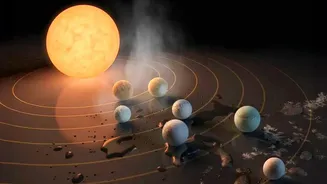
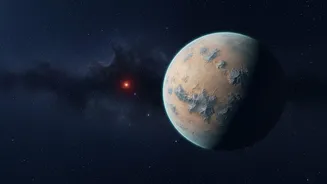
Just 40 light-years away, the TRAPPIST-1 system has long been a beacon of hope for astrobiologists. It features seven Earth-sized rocky planets orbiting a small, cool red dwarf star. Three of these planets—TRAPPIST-1e, f, and g—reside in the so-called
“habitable zone,” a region where temperatures could theoretically allow for liquid water on the surface, a key ingredient for life as we know it. The system's discovery in 2017 sparked a wave of excitement, turning these worlds into prime targets for our most powerful observatories. The promise was immense: a nearby, compact solar system offering a natural laboratory to study the formation and potential habitability of terrestrial planets.
The Telescope’s Unblinking Gaze
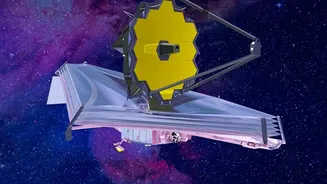
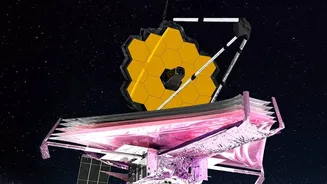
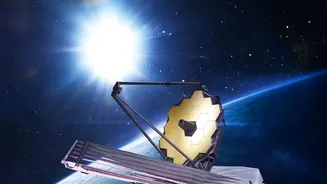
Enter the James Webb Space Telescope. Its powerful infrared instruments allow astronomers to do something remarkable: peek into the atmospheres of these distant worlds. Using a technique called transmission spectroscopy, JWST observes a planet as it passes in front of its star. The starlight filters through the planet's atmosphere, and different gases absorb specific wavelengths of light. By analyzing the resulting spectrum, scientists can identify the chemical components present. Another method involves measuring the planet's thermal emission—its heat—as it passes behind the star, which can reveal details about temperature and atmospheric presence. It’s through these incredibly sensitive measurements that the story of the TRAPPIST-1 planets is beginning to unfold.
The Search for an Atmosphere
The headline's mention of “heavy carbon gases,” like carbon dioxide (CO2), touches on a critical question: do these planets have atmospheres at all? The initial findings from JWST have been sobering. Observations of the two innermost planets, TRAPPIST-1b and TRAPPIST-1c, have largely ruled out thick, substantial atmospheres. Data suggests TRAPPIST-1b is likely a bare rock, while TRAPPIST-1c, if it has an atmosphere, possesses an extremely thin one at best. Scientists had once theorized that TRAPPIST-1c could be a Venus-like world with a dense CO2 atmosphere, but JWST’s measurements of its thermal glow showed no evidence for this. Some recent analyses suggest a hazy CO2 atmosphere or volcanic activity could still be possible on TRAPPIST-1b, but the evidence remains contested and difficult to parse from the star's own activity.
Not Venus, Not Earth, But Something New
For the planets further out, including those in the habitable zone, the picture is still developing. Studies of TRAPPIST-1d have also failed to find a thick, Earth-like atmosphere. On TRAPPIST-1e, one of the most promising candidates for habitability, JWST has ruled out a puffy, hydrogen-dominated atmosphere, but the results are still consistent with either a bare rock or a heavier, nitrogen-based atmosphere, perhaps with traces of methane. The absence of a thick CO2 atmosphere on the inner planets is telling. It suggests these worlds may have formed with very little water and other volatiles needed for habitability, a worrying sign for their cooler siblings further out. The intense radiation from the parent red dwarf star may have stripped away any atmospheres these planets once had.
What This Reveals to Astrobiologists
While the lack of thick, inviting atmospheres may seem disappointing, for astrobiologists, this is crucial new information. The data from JWST is replacing speculation with hard evidence. The finding that the inner TRAPPIST planets are likely airless rocks provides a vital reality check. It demonstrates the harsh environment around many red dwarf stars and tempers expectations for finding life in such systems. The difficulty in getting a clear signal also highlights the immense challenges of this work; the activity of the star itself can mimic or obscure the faint signals from a planet’s atmosphere. Every null result sharpens our understanding and refines the search, teaching scientists what not to look for and where to focus their efforts next. The TRAPPIST-1 system is teaching us just how fragile planetary atmospheres might be.