



A New Foundation for Science
At the heart of NASA's strategy is the development of AI "foundation models." Think of these not as specific tools for one job, but as a versatile, AI-powered brain trained on decades of complex data. In partnership with companies like IBM, NASA has created
models like 'Prithvi' (the Sanskrit name for Earth) and 'Surya' (for the Sun). These are trained on enormous datasets, such as 40 years of climate information or a decade of solar observations. By making these models open-source, NASA allows scientists worldwide to adapt them for specific tasks, from tracking burn scars left by wildfires to identifying floodwaters, accelerating discovery for everyone.
Monitoring Earth's Climate from Above
Our planet is sending us signals, and AI is helping us listen more closely. NASA's satellites generate an overwhelming amount of data—an estimated 250,000 terabytes by 2024 alone. Artificial intelligence is crucial for sifting through this information to find meaningful patterns. For example, AI algorithms can analyze satellite imagery to predict crop yields, forecast seasonal precipitation, and track the intensity of hurricanes. This has direct, life-saving applications. In the aftermath of hurricanes, AI has been used to scan images and count blue tarps on damaged roofs, providing a rapid assessment of community devastation for disaster relief teams. This ability to quickly process data turns observation into actionable intelligence, helping communities build resilience against climate change.
Smarter Satellites and Bolder Exploration
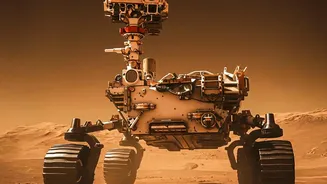
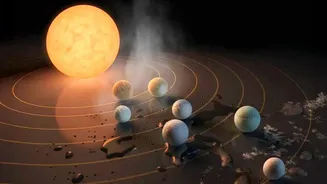
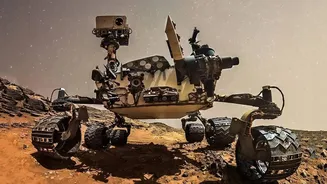
In space, delays are measured not in minutes, but in millions of kilometers. AI is making spacecraft more autonomous and efficient, reducing the need for constant human intervention. The Perseverance rover on Mars, for instance, uses AI to navigate the treacherous Martian landscape on its own, identifying hazards and choosing the safest path. Its instruments can also autonomously select rock samples for chemical analysis, a crucial task in the search for ancient life. Beyond Mars, AI systems like ExoMiner sift through data from telescopes like Kepler, and have already identified hundreds of new planets that might have been missed by human analysts. This technology is not just about seeing more of space; it’s about understanding it faster and more accurately than ever before.
Giving Spacecraft Real-Time Brains
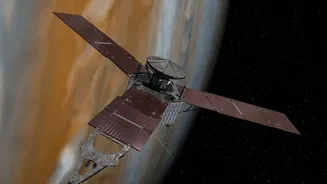
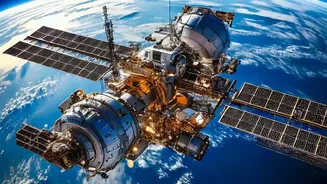
One of the most revolutionary developments is giving satellites the ability to think for themselves. A new system called Dynamic Targeting allows an Earth-observing satellite to analyze imagery with onboard AI and decide in real-time what to capture. Instead of blindly taking photos of cloud-covered areas, the satellite can scan ahead, identify clear skies or a significant event like a wildfire, and then take a valuable picture—all without waiting for a command from Earth. The entire process can take less than 90 seconds. This makes data collection vastly more efficient, saving bandwidth and battery while ensuring that the information sent back is useful and timely, especially during fast-moving disasters.
The Future of AI in Space
NASA's push into AI is just beginning. The agency has announced its participation in the Genesis Mission, a federal initiative to apply advanced machine learning across a staggering 150 petabytes of space data. The goal is to slash analysis times from years to days, speeding up everything from mission planning to lunar logistics. Future applications could include using AI to monitor astronaut health on long-duration missions or even allowing operators to communicate with satellites using natural language. By integrating AI into every facet of its operations, NASA is not only aiming to answer the biggest scientific questions but is also building a more efficient and intelligent future for exploration.