



From a Snapshot to a Live Feed
For most of history, astronomy has been like looking at a collection of old photographs. We could see where galaxies were, but not how they were moving or changing in the moment. That is no longer the case. The headline-grabbing phrase "real-time data"
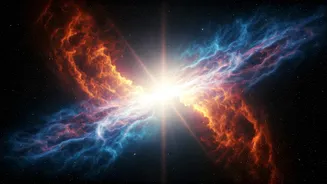
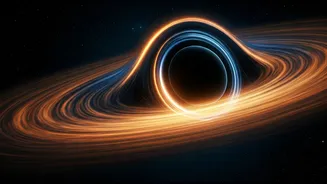
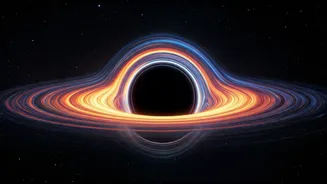
refers to two revolutionary technologies. First, gravitational wave observatories like LIGO and Virgo detect the faint ripples in spacetime itself, created when massive objects like black holes collide. These are not images, but rather cosmic sounds that arrive at Earth, giving us live alerts of cataclysmic events happening billions of light-years away. Second, the Event Horizon Telescope (EHT), a planet-sized network of radio dishes, has given us the first-ever direct images of the shadows of supermassive black holes. Together, these tools have turned the universe from a static picture into a live broadcast.
Black Holes as Cosmic Measuring Sticks
One of the biggest questions in cosmology is determining how fast the universe is expanding, a value known as the Hubble constant. For decades, different measurement methods have produced conflicting results, creating a major headache for physicists. Enter black holes. When two black holes or neutron stars merge, they release a torrent of gravitational waves. By analysing the precise shape of these waves, scientists can calculate the exact distance to the event. This technique, called a "standard siren," is an entirely new and independent way to create a map of the cosmos. For example, the first observation of a neutron star merger in 2017 provided a powerful new measurement of the Hubble constant, helping to refine our understanding of the universe's scale and age. Each new detection adds another data point, steadily redrawing our cosmic map.
Rewriting the Story of Galaxies
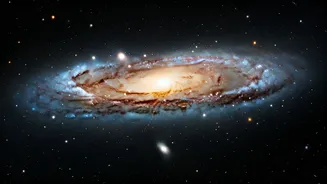
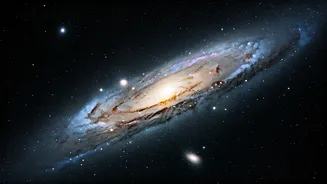
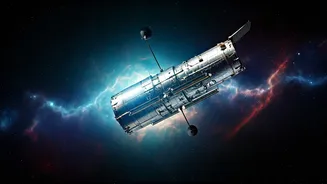
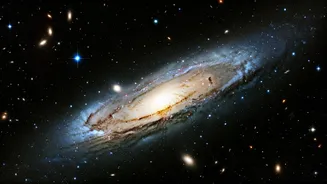
We know that supermassive black holes, millions or billions of times the mass of our sun, lurk at the centre of most galaxies, including our own Milky Way. For a long time, they were seen as passive giants. However, recent observations are showing they are active engines of galaxy formation. Data from telescopes like the James Webb Space Telescope (JWST) is revealing ancient black holes that are far too large to be explained by traditional models. They seem to have grown much faster and much earlier than previously thought, suggesting they played a co-starring role in building the very first galaxies. Recent simulations, informed by this new data, also show that magnetic fields around these giants play a crucial role in feeding them, allowing them to grow at ferocious rates and profoundly influence the stars that form around them.
India’s Growing Role in the Cosmos
India is playing a significant and growing part in this new era of astronomy. Indian scientists have made crucial contributions to analysing gravitational wave data and developing algorithms that help pinpoint cosmic events. Furthermore, the country is set to become a major hub for gravitational wave detection itself. The LIGO-India project, a collaboration to build a new observatory in Maharashtra, broke ground in April 2026. When it comes online around 2030, it will join the global network of detectors, dramatically improving our ability to locate gravitational wave sources in the sky and unlock the secrets they hold. This places India at the forefront of a scientific revolution, ready to help write the next chapter of cosmic history.