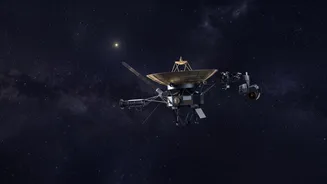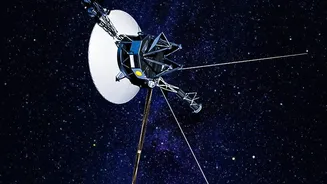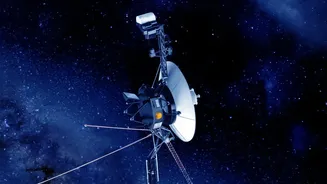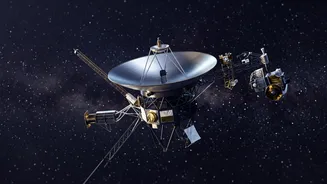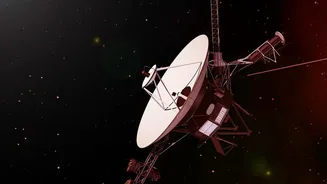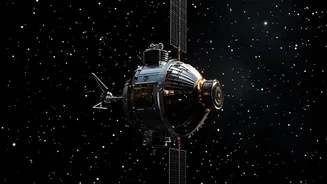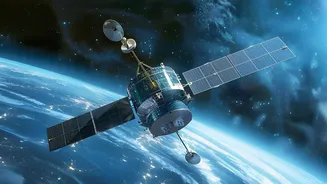



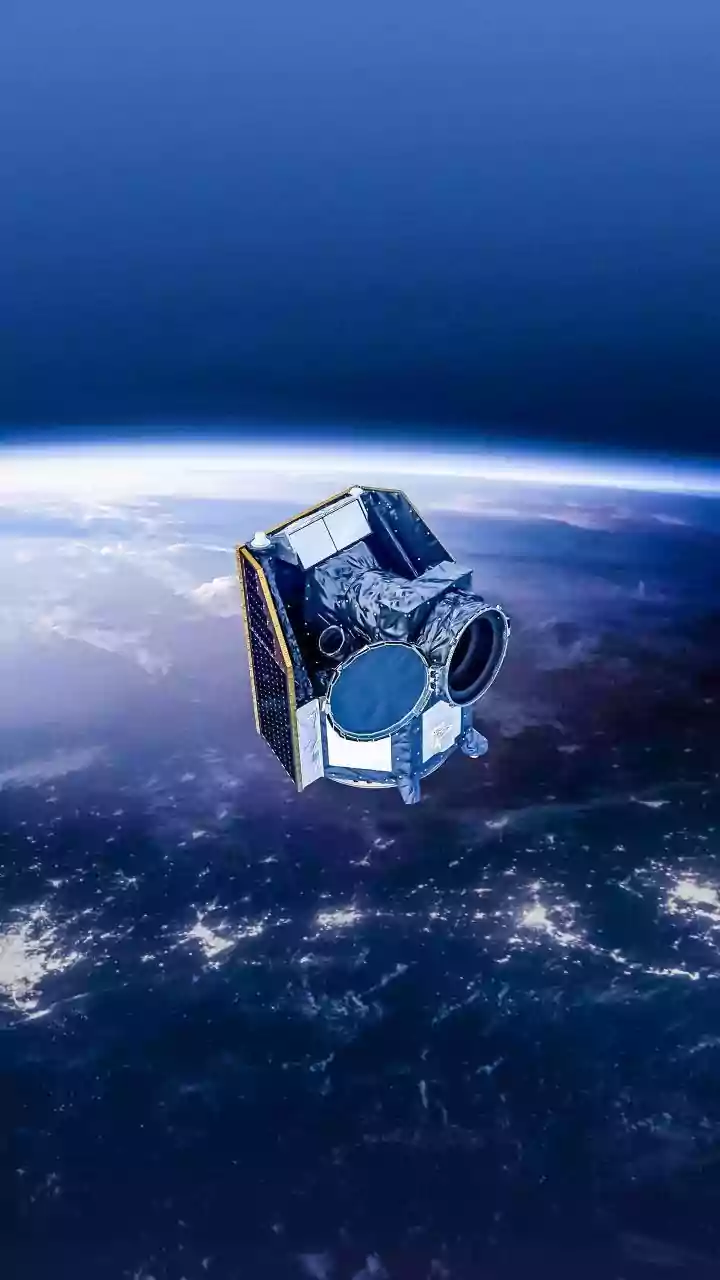

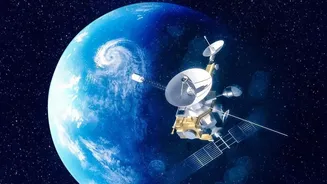
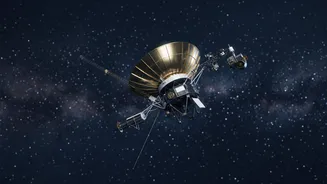
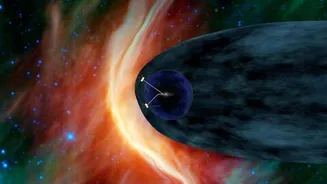
On November 18, humanity's farthest emissary, Voyager 1, will reach a milestone that sounds like science fiction: it will be one light-day away from us. This incredible distance changes everything about how we talk to our most distant probe.
A Journey Measured in Light
It’s a distance
so vast it’s almost impossible to comprehend. On November 18, 2026, after nearly 50 years of hurtling through space, NASA's Voyager 1 probe will be 25.9 billion kilometres from Earth. This isn't just a random number; it marks the first time a human-made object has travelled a 'light-day' away from our planet. A light-day is the distance that light, the fastest thing in the universe, travels in 24 hours. While light from the Sun takes just over eight minutes to reach us, a signal sent from Earth on November 18 will take a full day to reach Voyager 1. This milestone has no physical effect on the spacecraft itself, but it serves as a powerful symbol of its endurance and the immense scale of the cosmos it now explores.
The 48-Hour Conversation
The light-day milestone fundamentally alters our connection to the probe. Communicating with Voyager 1 is no longer a conversation; it's an exercise in extreme patience. Sending a command—a simple 'hello' or a complex diagnostic instruction—requires a 24-hour wait for the message to arrive. Then, engineers on the ground must wait another 24 hours for Voyager’s reply to travel back across the void. This 48-hour round trip makes real-time control impossible. As Voyager Project Manager Suzanne Dodd puts it, 'If you want to say 'hello' to Voyager, you send your message and then you go home and you wait two days before you finally get a response'. Every interaction is a slow, deliberate exchange with a machine now deep in interstellar space, far beyond the influence of our Sun.
An Aging Explorer's Resilience
Voyager 1's journey has been anything but smooth. Launched in 1977, the probe has faced numerous close calls that have tested the ingenuity of its Earthbound engineers. Between November 2023 and June 2024, the spacecraft sent back unreadable 'gibberish' due to a faulty memory chip, a problem engineers painstakingly solved by splitting up and relocating code. More recently, in October 2026, the probe went silent for 48 hours when its signal was unexpectedly lost, only to reappear on its own before a fix could be sent. Engineers discovered an automated switch to backup thrusters had occurred. These incidents, coupled with a dwindling power supply from its plutonium generators, which lose about four watts of power per year, have required creative solutions like the 'Big Bang' maneuver in September 2026, which swapped out devices to conserve precious energy and extend the mission's life.
A Message in a Cosmic Bottle
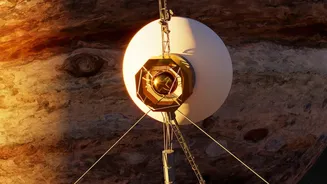
Beyond its scientific instruments, Voyager 1 carries a message from humanity: the Golden Record. This 12ndndndnd inch, gold plated copper disc is a time capsule, designed to last for a billion years. Curated by a team led by famed astronomer Carl Sagan, it contains 116 images, sounds of Earth like wind and whales, musical selections from Bach to Chuck Berry, and spoken greetings in 55 languages. It also carries a map showing our solar system's location relative to 14 pulsars. While the chances of it being found by an extraterrestrial intelligence are minuscule, the record represents a hopeful gesture from our civilization. It transforms the probe from a mere scientific instrument into a cultural ambassador, carrying a piece of our world into the galactic night. Voyager $^$ journey will continue long after its signal fades; in about $^$40$,$$$oo years$,$$$ it is projected to pass near the star Gliese $^$445.