



A Glimpse into the Cosmic Dawn
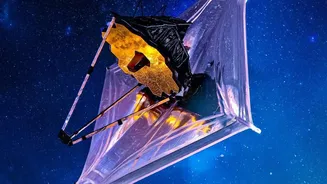
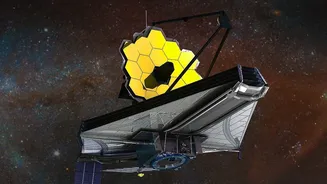
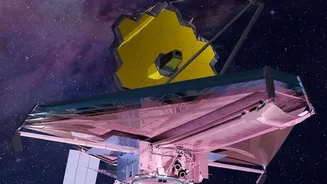
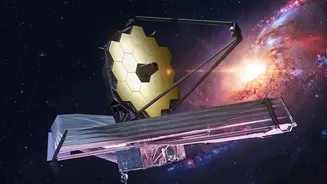
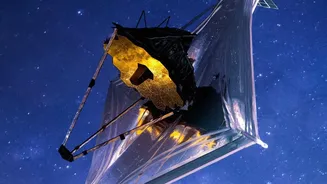
Imagine looking across thirteen billion years of cosmic history. That’s what astronomers have done, using the powerful infrared vision of the JWST. They found a pair of quasars, designated J1602+4228AB, shining from an era known as the 'cosmic dawn'.
This period is when the very first stars and galaxies were beginning to form. Finding one quasar from this time is rare, but finding two so close together is unprecedented. The two objects are separated by just 18,100 light-years, which sounds vast but is actually less than one-fifth the diameter of our own Milky Way galaxy. This discovery, part of a JWST survey called Aether, provides a stunning, real-life snapshot of two galaxies in the process of merging at the very beginning of the universe.
What Exactly Is a Quasar?
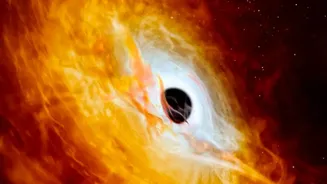
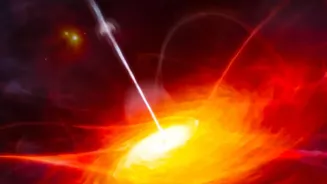
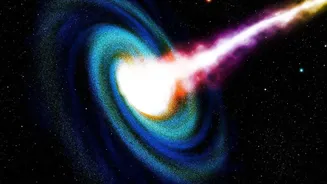
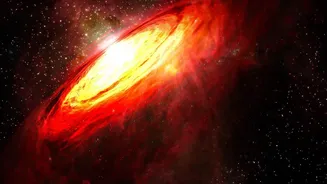
So, what are these brilliant objects? A quasar, short for 'quasi-stellar radio source', is essentially a beacon powered by a supermassive black hole. It is not the black hole itself that shines, but the enormous disk of gas and dust swirling around it. As material gets pulled in by the black hole’s immense gravity, it heats up to millions of degrees, creating a blindingly bright accretion disk that can outshine all the stars in its host galaxy combined. Because they are so intensely luminous, quasars are visible across immense cosmic distances, allowing astronomers to use them as probes to study the conditions of the early universe.
A Pair That Puzzles Scientists
Finding this pair, given the Hawaiian name Nāpōwawāʻenakaulua, is a huge deal because it challenges our understanding of how quickly things grew in the early universe. One of the black holes is estimated to have a mass of 1.5 billion times that of our sun, while its companion is around 400 million solar masses. According to existing models, there simply shouldn't have been enough time—just 900 million years since the Big Bang—for black holes to grow this enormous. As lead researcher Silvia Onorato from NSF's NOIRLab stated, there is no definitive theoretical explanation for how even a single one of these giant quasars could exist so early, let alone two. While there's a small chance the image could be a 'gravitational lens'—a single object duplicated by the gravity of something in front of it—subtle differences in the light spectra of the two sources strongly suggest they are a genuine pair.
Evidence of a Cosmic Traffic Jam
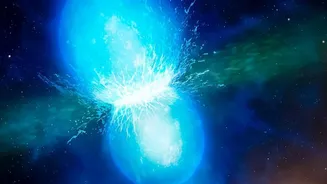
The discovery of Nāpōwawāʻenakaulua provides the first direct evidence for something long suspected: the early universe was a chaotic and crowded place. In this primordial era, galaxies were smaller and closer together, leading to frequent collisions and mergers. Such mergers are the primary way that large galaxies are thought to assemble. When two galaxies merge, their central supermassive black holes are drawn toward each other, feasting on the abundant gas and dust churned up by the collision. This intense feeding frenzy ignites them both as quasars. This pair is a living laboratory for studying this fundamental process of galaxy and black hole co-evolution, caught in the act.
Why This Changes Our Cosmic Story
This finding isn't just about two distant bright spots; it forces a rewrite of the opening chapters of cosmic history. The sheer mass of these black holes suggests that their growth was far more rapid and efficient than previously believed. It hints that the 'seeds' of black holes in the early universe may have been much larger than theorised, or that they found ways to feed and grow at an accelerated rate. The existence of this pair suggests the region they inhabit was an exceptionally dense node in the cosmic web, a place where matter was concentrated, fueling furious star formation and black hole growth simultaneously. The JWST, by spotting what was previously unseeable, is consistently finding that the early universe was more mature and structured than we ever imagined.