







Pune’s Traditional ‘Manache Ganpati’
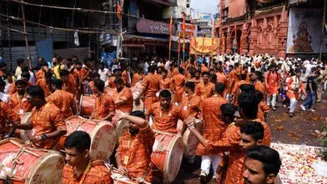
Step back in time in Pune, the city where the public Ganeshotsav was revived by Lokmanya Tilak in 1893. The celebration here is steeped in history, centered around the five 'Manache Ganpati' or 'Respected Ganpatis'. Each of these revered idols, starting
with the Kasba Ganpati, has a specific honour in the immersion procession. Unlike the thematic pandals of Mumbai, Pune’s focus is on tradition, with beautifully decorated temples and disciplined, culturally rich processions featuring dhol-tasha drum troupes. It offers a chance to witness the festival in its historical birthplace, where devotion and heritage take centre stage.
Goa’s Family-Focused ‘Chavath’
In Goa, Ganesh Chaturthi, locally known as 'Chavath', is a deeply personal, family-oriented affair. Many Goans return to their ancestral homes for celebrations that can last from one-and-a-half to 21 days. A standout tradition is the 'Matoli', a wooden canopy hung above the idol, adorned with seasonal, local fruits, vegetables, and herbs. This practice roots the festival in nature and the harvest. The focus is less on public spectacle and more on home-based rituals, family reunions, and enjoying traditional Goan sweets like 'Nevri' and 'Modaks'. The immersion ceremonies at scenic beaches like Miramar add a unique coastal flavour.
Karnataka’s Joint ‘Gowri Ganesha Habba’
In Karnataka, the festival is often a two-part celebration known as Gowri Ganesha Habba. A day before Ganesh Chaturthi, families worship Goddess Gowri (Ganesha's mother, Parvati), welcoming her into their homes. It is believed that Ganesha arrives the next day to take her back to Kailash. This tradition, particularly significant for married women, adds a unique narrative layer to the festivities. Idols of both Gowri and Ganesha are worshipped together. The state blends grand public celebrations in cities like Bengaluru with intimate, home-focused rituals, featuring local delicacies like 'kadubu' and 'panchakajjaya'.
Hyderabad’s Towering Khairatabad Ganesha
For an experience defined by sheer scale, nothing compares to the Khairatabad Ganesha in Hyderabad. A tradition since 1954, this single idol is one of the tallest installed in India each year, often towering over 60 feet. Millions of devotees visit during the 11-day festival to witness this colossal symbol of faith. While it is a pandal, the experience is not about hopping between many, but about participating in the singular, massive gathering focused on one monumental idol. The festival culminates in a grand immersion procession to Hussain Sagar Lake, a spectacle that draws enormous crowds.
Tamil Nadu’s Devotional ‘Vinayaka Chaturthi’
Known as Vinayaka Chaturthi in Tamil Nadu, the festival here is characterized by its focus on devotion and simplicity. Many families prefer to use homemade clay idols, painted with natural pigments. While public pandals exist, the emphasis is often on personal worship at home and in ancient temples like the Karpaga Vinayagar Temple in Pillayarpatti. The offerings are also distinct, with sweet and savoury versions of 'kozhukattai' (a rice flour dumpling similar to modak) and 'sundal' (a dish made of legumes) being central to the prasad. The celebration is typically shorter, often lasting for just a few days.
The Hands-On Joy of Idol Making Workshops
For a truly personal connection to the festival, an increasingly popular experience is participating in an eco-friendly idol-making workshop. Available in many cities, these workshops teach you to craft your own Ganesha from natural clay (shadu mati). This revives an old tradition of making idols at home and fosters an understanding of the festival's environmental impact. Creating an idol with your own hands, which then becomes the centerpiece of your family's puja, offers a deeply satisfying experience that goes beyond passive observation. It’s a creative and sustainable way to engage with the festival's core spirit.
The Intimate Rituals of a Home Celebration
Perhaps the most authentic experience of all is to witness or participate in a home celebration. Across India, families welcome Ganesha into their houses for periods ranging from a single day to ten. This involves the ritual of 'pranapratishtha' (invoking life into the idol), daily morning and evening aartis, the singing of bhajans, and the preparation of homemade bhog. It’s an opportunity to see the intricate, personal side of the festival: the careful decoration of a small home altar, the distribution of prasad among neighbours, and the bittersweet farewell during a home-based visarjan. This intimate scale reveals the deep, personal faith that underpins the grand public festivities.