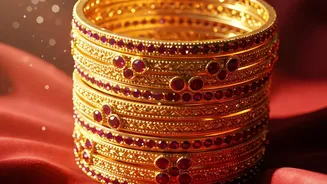







Why Gold Prices Fluctuate Daily
The price of gold isn't arbitrary; it’s a complex interplay of global and local factors. International market trends set the baseline, as gold is traded worldwide and priced in US dollars. When the dollar strengthens against the Indian rupee, the cost
to import gold increases, pushing domestic prices up. Beyond currency rates, factors like global economic uncertainty, inflation, and interest rate changes play a significant role. During turbulent times, investors often flock to gold as a 'safe-haven' asset, increasing its demand and price. In India, local demand during festival and wedding seasons, along with government policies like import duties and GST, add another layer to the final price you see at the jeweller.
Deconstructing the Jeweller's Bill
The price tag on a piece of jewellery is not just the value of the gold. The final amount on your bill is a sum of several components. The primary part is the base value of the gold, calculated by multiplying its weight by the day's gold rate for its specific purity. To this, jewellers add 'making charges,' which cover the cost of craftsmanship and can be a significant portion of the final price. Some may also include 'wastage charges' for gold lost during the manufacturing process. Finally, a 3% Goods and Services Tax (GST) is levied on the total value of the gold plus the making charges. A transparent jeweller will provide an itemised bill showing each of these components separately.
The Importance of Purity and Hallmarking
Gold jewellery in India is primarily available in 22 Karat (91.6% pure gold), 18 Karat (75% pure gold), and 14 Karat (58.3% pure gold). 24 Karat gold is 99.9% pure but too soft for most jewellery and is typically used for coins and bars. To ensure you get the purity you pay for, the Bureau of Indian Standards (BIS) has a mandatory hallmarking system. A hallmarked piece will have the BIS logo, its purity grade (e.g., 22K916), and a unique six-digit alphanumeric Hallmark Unique Identification (HUID) number. This HUID allows you to verify the item's details, including the jeweller and the assaying centre, using the BIS CARE mobile app, offering a robust layer of consumer protection.
Navigating Making Charges
Making charges are perhaps the most variable and negotiable part of a jewellery bill. They can range from as low as 6% to over 25% of the gold's value, depending on whether the piece is machine-made or requires intricate handwork. Unlike the value of the gold itself, making charges are a cost that you don't recover upon resale. Therefore, it pays to be savvy. Always ask if the charge is a percentage of the gold's value or a fixed rate per gram. Don’t hesitate to compare making charges across different jewellers for similar designs. Often, simpler, machine-made designs have lower making charges. For larger purchases, especially during wedding shopping, many jewellers are open to negotiation.
Timing Your Purchase Wisely
While timing the market perfectly is impossible, a little strategy can help. Gold prices tend to rise in anticipation of peak seasons like Diwali, Dhanteras, and the wedding season due to increased demand. Buying during the off-season may offer a slight advantage. Keep an eye on market trends; significant price dips can present buying opportunities. However, rather than trying to predict a low point, a more practical approach for many is to buy consistently over time to average out the cost. Some buyers choose to purchase gold coins or bars when prices are favourable and later exchange them for jewellery, paying only the making charges. This strategy allows you to lock in the gold rate while deferring the choice of design.
Considering Digital vs. Physical Gold
While buying jewellery serves a cultural and aesthetic purpose, if your primary goal is investment, it's worth knowing the alternatives. Physical jewellery incurs making charges and GST, which can diminish its value as a pure investment, as these costs are not recouped on selling. Digital options like Gold Exchange Traded Funds (ETFs) and Sovereign Gold Bonds (SGBs) offer a way to invest in gold without these additional costs. Gold ETFs are traded on the stock exchange and aim to track the domestic price of gold, offering high liquidity. SGBs, issued by the RBI, not only reflect the gold price but also pay a small annual interest. These instruments can be a cost-effective way to build a gold portfolio, separating the investment goal from the desire for physical jewellery.