




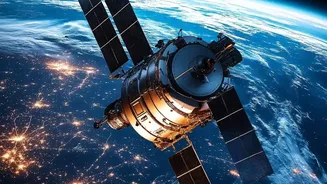
The next frontier for cloud computing isn't on Earth—it's in orbit. A new wave of 'megaconstellations' designed as flying data centres is on the horizon, promising to meet AI's insatiable energy needs. But this innovation comes at a high price.
Data Centres in the Sky
The concept
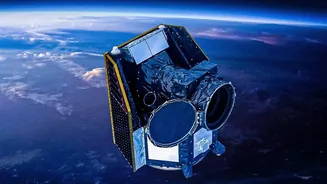
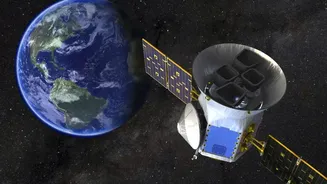
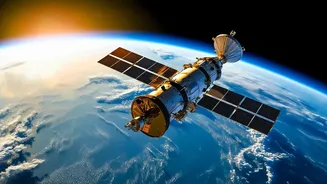
of a data centre in space sounds like science fiction, but it's quickly becoming a serious business plan for major tech and aerospace companies. Firms like SpaceX, Google, and Blue Origin, as well as startups like Starcloud, are exploring the idea of placing massive server farms in low-Earth orbit. The primary motivation is to overcome the terrestrial constraints of land, power, and water that limit the growth of artificial intelligence. Orbital data centres could harness near-constant solar energy and use the vacuum of space for cooling, offering a seemingly elegant solution to the exploding energy demands of AI. Proposals involve launching tens of thousands, and in some cases, up to a million satellites to create a powerful, interconnected computing network above the clouds. While the engineering challenges are immense, early test satellites are already in orbit, proving that components can survive the launch and operate in space.
A New Kind of Light Pollution
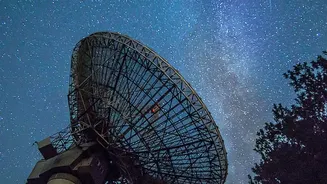
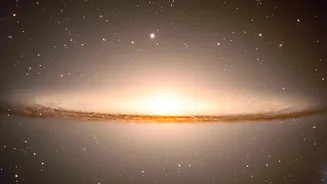
For astronomers, this orbital expansion represents an existential threat. The problem isn't just the individual satellites, but their cumulative effect. Ground-based telescopes, which capture faint light from distant galaxies and stars, are extremely sensitive. When a sunlit satellite passes through a telescope's field of view, it leaves a bright streak across the image, rendering that data useless. Unlike city lights, this form of light pollution cannot be escaped by moving to remote locations; there is nowhere on Earth to hide from a sky filled with satellites. Furthermore, the sheer number of planned satellites will do more than just create streaks. Their combined, diffuse reflection threatens to raise the overall brightness of the night sky, effectively creating a permanent twilight that would drown out the faintest and most distant objects in the universe. A study from the European Southern Observatory warns that some proposals could make the night sky three to four times brighter.
The Scale of the Problem
The numbers are staggering. Since 2019, the number of active satellites has grown dramatically, largely due to constellations like SpaceX's Starlink. But current proposals dwarf what is already in orbit. Plans have been filed for over 1.7 million new satellites. Even if only a fraction of these are launched, experts predict over 100,000 active satellites within the next decade. This proliferation affects more than just optical astronomy. The satellites also emit radio waves that can interfere with radio telescopes, which listen for incredibly weak signals from cosmic phenomena like black holes and pulsars. Even space-based telescopes like the Hubble are not immune, as they share orbital space with these new constellations. Projections suggest that if all planned satellites are deployed, nearly 40% of Hubble's images could be contaminated. For future wide-field survey telescopes like the Vera C. Rubin Observatory, the impact is even more severe, with predictions that 30-50% of twilight observations could be seriously affected.
A Search for Solutions
The astronomical community is not standing still. Organizations like the American Astronomical Society and the International Astronomical Union are in active dialogue with satellite operators to find ways to mitigate the damage. Several strategies are being tested. One approach is to make the satellites themselves less reflective. SpaceX has experimented with a 'DarkSat' prototype with an anti-reflective coating and a 'VisorSat' that uses a sunshield to block light from hitting the shiniest parts of the satellite. Another key recommendation is to keep satellites in lower orbits, below 600 kilometers. At this altitude, they enter Earth's shadow for more of the night and are less likely to interfere with observations. Additionally, providing precise, publicly available orbital data allows observatories to plan their observations and, if necessary, momentarily close a telescope's shutter as a satellite passes. However, no single solution is a silver bullet, and astronomers maintain that the most effective mitigation would be to simply launch fewer satellites.