







Why Restorative Stretches Matter
Long hours spent hunched over a keyboard create a familiar pattern of physical stress. Your shoulders round forward, your neck cranes towards the screen, and your lower back aches from prolonged sitting. This isn't just physical discomfort; it's a physiological
stress response. Restorative yoga focuses on gentle movements and supported postures to calm the nervous system. Unlike a fast-paced workout, the goal here is not to build muscle but to release deep-seated tension, improve circulation to stiff areas, and encourage a state of mental calm. By taking just a few minutes to consciously move and breathe, you can interrupt the body's stress cycle, increase blood flow, and return to your work feeling more focused and less physically strained.
1. Seated Cat-Cow for Spine Mobility
This classic yoga sequence is brilliant for waking up the spine and releasing tension from the neck to the tailbone. It's easily adapted for your office chair. **How to do it:** Sit upright in your chair with your feet flat on the floor and your hands resting on your knees. As you inhale, arch your spine, roll your shoulders back, and lift your chest, looking slightly upward (Cow Pose). As you exhale, round your spine, drop your chin to your chest, and let your shoulders and head fall forward (Cat Pose). Flow between these two movements for 5-8 breaths, synchronising your breath with the motion. This gentle movement helps counteract the static, hunched posture of desk work, promoting spinal flexibility and relieving lower back stiffness.
2. Neck Rolls and Tilts
Our necks hold a surprising amount of tension from staring at screens. These simple movements can provide immediate relief. **How to do it:** Sit tall and gently drop your right ear towards your right shoulder, holding for 15-20 seconds. You should feel a gentle stretch along the left side of your neck. Slowly return to the centre and repeat on the left side. Next, drop your chin to your chest and slowly roll your head from shoulder to shoulder. Avoid rolling your head all the way back, as this can compress the vertebrae in your neck. Perform 3-5 slow rolls in each direction to release tightness in the neck and upper shoulders.
3. Eagle Arms for Shoulder Relief
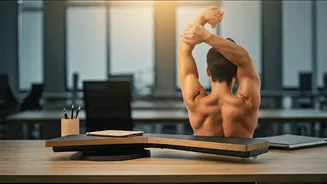
This pose provides a deep stretch for the upper back and the often-tight area between the shoulder blades, a common casualty of typing and mousing. **How to do it:** Extend your arms straight out in front of you. Cross your right arm over your left, then bend your elbows. Try to bring your palms to touch; if they don't reach, simply press the backs of your hands together. Lift your elbows slightly and gently press your hands away from your face to deepen the stretch across your upper back. Hold for 3-4 deep breaths. Unwind your arms, shake them out, and repeat with the left arm crossed over the right. This pose is a fantastic antidote to 'desk slump'.
4. Seated Forward Fold
A forward fold is not just a hamstring stretch; it's also incredibly calming for the nervous system. This seated version is perfect for a quick mental reset. **How to do it:** Sit towards the edge of your chair with your feet flat on the floor and knees hip-width apart. With a long spine, slowly hinge at your hips and fold your torso over your thighs. Let your head and neck hang heavy, and allow your arms to dangle towards the floor. Stay in this pose for 30-60 seconds, breathing deeply into your back. The gentle compression on the abdomen and the release in the neck and back can help soothe anxiety and quiet a busy mind. To come out, slowly roll up one vertebra at a time.
5. Wrist and Finger Stretches
Don't forget your hands! Constant typing and clicking can lead to stiffness and strain in the wrists and fingers. Regular stretching can help maintain flexibility. **How to do it:** Extend your right arm forward, palm facing up. With your left hand, gently bend your right fingers down towards the floor until you feel a stretch in your forearm. Hold for 20 seconds. Then, flip your palm to face down and use your left hand to gently press your fingers towards your body. Hold for another 20 seconds. Repeat on the other arm. Finish by spreading your fingers wide and then making a tight fist, repeating this 5-10 times to improve circulation.