


A New Sentinel in Space
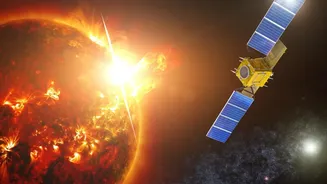
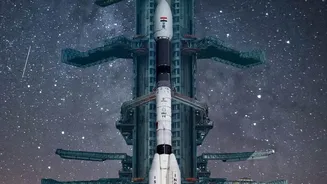
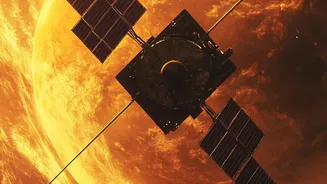
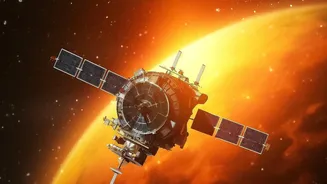
Since its launch, the Aditya L1 mission has represented a giant leap for Indian space science. Positioned at Lagrange Point 1 (L1), about 1.5 million kilometres from Earth, the spacecraft has an uninterrupted, 24/7 view of our star. This unique vantage
point is crucial for its primary goal: to observe the Sun continuously and understand the dynamics that affect space weather. While its mission is broad, a key part of its mandate is to provide data that can help us prepare for solar tantrums—violent eruptions that can have serious consequences for our technology-dependent world. Recent data transmissions confirm that its sophisticated instruments are working as planned, offering scientists a firehose of new information to decode the Sun's behaviour. This represents a significant milestone, transitioning India from a user of global space weather data to a primary producer of it.
Decoding the Fiery Corona
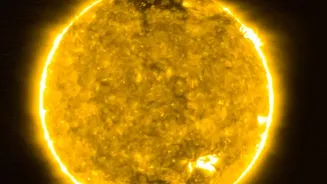
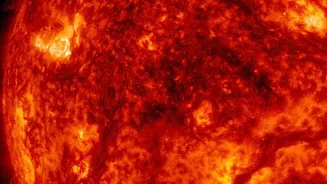
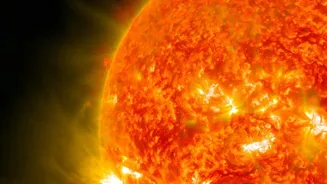
The latest breakthrough involves data from the Sun's corona, its enigmatic outer atmosphere. The corona is a puzzle for scientists because it is millions of degrees hotter than the Sun's visible surface, which is a comparatively cool 5,500 degrees Celsius. Understanding why has been a long-standing mystery. Aditya L1's payloads, particularly the Visible Emission Line Coronagraph (VELC) and the Solar Ultraviolet Imaging Telescope (SUIT), are designed to tackle this. The VELC can block the Sun's bright face to get a clear look at the much fainter corona, observing how energy moves and how massive eruptions like Coronal Mass Ejections (CMEs) are born. Recent findings from Aditya L1, published in the Astrophysical Journal Letters, suggest that the constant snapping and reconnecting of magnetic field lines is the primary source of the corona's intense heat, accounting for as much as 93% of the required energy. This fundamental discovery is crucial for improving the physical models that underpin space weather forecasts.
The Threat of Solar Storms
So, why does this matter for us on Earth? The same processes that heat the corona also power solar storms. These events, especially CMEs, hurl vast clouds of charged particles and magnetic fields into space. If a powerful CME is aimed at Earth, it can trigger a geomagnetic storm. Such a storm can have devastating effects, disrupting our modern way of life by damaging satellites, scrambling GPS and communication signals, and even knocking out power grids. With India's economy becoming increasingly digital and our infrastructure more interconnected, the vulnerability to such an event is higher than ever. ISRO alone has space assets worth crores that are at risk. A severe geomagnetic storm could affect everything from online banking and navigation for flights to the stability of our electricity supply.
Better Forecasts, Better Protection
This is where Aditya L1 becomes a critical line of defence. By observing the Sun's corona directly, it can see the tell-tale signs of a CME as it happens. The data on plasma movement, temperature changes, and magnetic field reconfigurations provides vital inputs for our prediction models. This allows for earlier and more accurate warnings about incoming solar storms. Having an advance warning—even just hours—gives satellite operators time to put their spacecraft into a protective safe mode. It also allows power grid managers to take precautions to prevent widespread blackouts and helps airlines reroute flights to avoid areas with high radiation and communication outages. Aditya L1's data helps improve the models that predict not just if a storm will hit, but how intense it will be, giving us a much better chance to mitigate the worst of its effects.
India's Place in the Sun
The successful data stream from Aditya L1 is more than just a scientific achievement; it's a statement about India's growing prowess in space exploration. Coming on the heels of the historic Chandrayaan-3 lunar landing, this mission cements ISRO's position as a world-class space agency capable of executing complex, deep-space science missions. By generating its own high-quality solar data, India is no longer just a participant in global science but a key contributor, laying the groundwork for future missions and strengthening international collaborations. The mission's findings are providing crucial benchmarks for solar physics worldwide, helping all of humanity better understand our nearest star and the space weather it creates. It’s a proud moment where Indian science is directly contributing to the safety and security of vital infrastructure both on Earth and in orbit.