


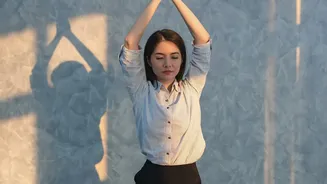
Ever found yourself wobbling in Tree Pose, convinced your balance has a mind of its own? The secret to finding stillness isn't just in your standing leg—it's in your breath. Let's explore why steady breathing is the ultimate anchor for stability.
The Science of a Steady Breath
To understand
why breathing is so crucial for balance, we need to look at the nervous system. Our body has two main operating modes: the 'fight or flight' (sympathetic) system and the 'rest and digest' (parasympathetic) system. When we’re stressed, anxious, or even just holding our breath in concentration, our sympathetic system kicks in. This creates muscle tension and a scattered mind—a recipe for falling over. Conversely, slow, deep, and steady breathing activates the parasympathetic nervous system. It sends a signal to your brain that you are safe, which allows your muscles to relax. A calm nervous system permits the tiny, almost imperceptible muscular adjustments in your foot and ankle that are essential for maintaining balance. Think of it this way: a tense, rigid body will topple like a stiff board, while a relaxed but engaged body can sway and adapt like a real tree in the wind.
Finding Your Roots in Basic Tree Pose
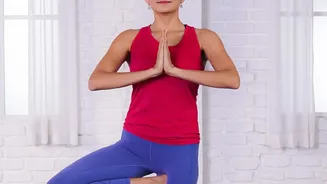
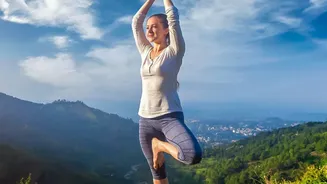
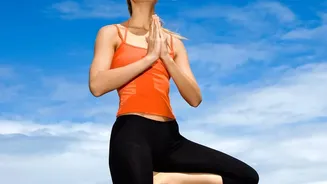
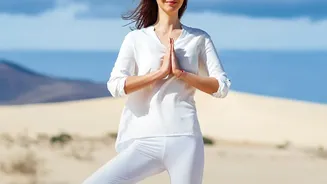
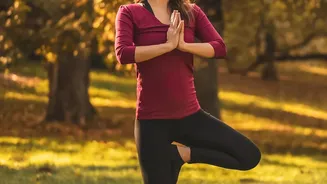
Before exploring variations, it's vital to master the fundamentals of Vrksasana (Tree Pose). Start in Mountain Pose (Tadasana), standing tall with your weight evenly distributed. Shift your weight onto one foot, engaging the muscles of the standing leg without locking the knee. Find a 'drishti', or a non-moving focal point at eye level, to help steady your gaze and mind. Then, bend your other knee and place the sole of your foot on your inner ankle, calf, or upper thigh—always avoiding direct pressure on the knee joint. Press your foot into your leg and your leg back into your foot to create a stable connection. Keep your hips level and facing forward. Your hands can start at your heart in a prayer position (Anjali Mudra). Breathe here. Notice the connection between the steadiness of your inhale and exhale and the stability of your pose.
Variations for Building Confidence
If you feel wobbly, don't be discouraged. Balance is a practice, not a destination. These modifications are excellent for building a strong foundation. The most accessible variation involves using a wall for support. Stand with your side or back to a wall and lightly touch it with your fingertips as needed. Another great option is to keep the foot low. You can place the sole of your bent-leg foot against your standing ankle, keeping your toes on the floor like a kickstand. This gives you a greater sense of stability while still allowing you to practice the alignment and hip-opening aspects of the pose. As you feel more stable, you can gradually move the foot up to the calf. Remember, where you place your foot is less important than the quality of your breath and focus.
Exploring Your Branches
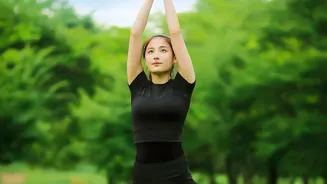
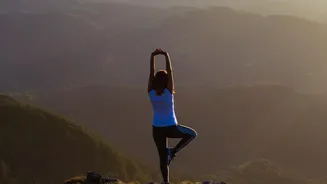
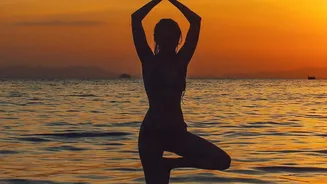
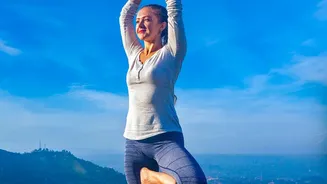
Once you feel stable with your foot on your calf or inner thigh, you can begin to explore different 'branch' variations with your arms. Extending your arms overhead, either parallel or with palms touching, instantly changes your center of gravity and challenges your balance further. You can also try a 'Windy Tree' by swaying your arms gently from side to side, which forces your core and standing leg to work harder. For a different kind of challenge, a gentle side bend adds a stretch for your waist while testing your stability. Another powerful variation is to simply close your eyes. This removes your visual focal point, forcing you to rely entirely on proprioception—your body's internal sense of where it is in space. Try it for just a breath or two at first.
Advanced and Restorative Options
For more experienced practitioners, Tree Pose can evolve further. The Half_Lotus Tree Pose (Ardha Padma Vrksasana) involves placing the top of the lifted foot onto the opposite hip crease, creating a much deeper hip opener. From there, you can even explore a forward fold. Another creative approach is the 'Twisted Tree', where you keep your hips square but gently rotate your upper body, adding another layer of complexity to your balance. On the other end of the spectrum, Tree Pose can be done restoratively. Lying on your back (Supta Vrksasana) or sitting in a chair allows you to experience the hip_opening benefits without any balance challenge at all, making the pose accessible to everyone.