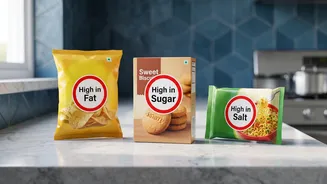








A New Look on the Front of the Pack
For years, understanding the nutritional content of packaged food meant flipping it over and deciphering a complex table of numbers in small print. That is set to change with the introduction of Front-of-Pack Labelling (FoPL). Under a new framework proposed
by FSSAI, you will soon see a distinct warning symbol on items that exceed certain health thresholds. The proposed design is a hard-to-miss red hexagon placed against a white square background, located prominently on the top-left of the package. This shift moves critical health information from the back of the pack to the front, allowing for quick, at-a-glance assessments while you shop.
Decoding the Red Hexagon Warning
The new label is designed for simplicity. Inside the red hexagon, you will see clear, simple text declaring a product as 'HIGH IN SUGAR', 'HIGH IN FAT', or 'HIGH IN SALT'. This system is meant to cut through marketing jargon like 'natural' or 'multigrain' that can sometimes mask unhealthy nutrient levels. In a significant move toward consumer transparency, the latest proposals state that a warning label will be required even if a product crosses the threshold for just one of these nutrients. If a food item is high in two or all three—for example, high in both sugar and fat—both will be listed within a single red hexagon, giving you a comprehensive warning in one symbol.
What 'High In' Actually Means
The term 'high' isn't arbitrary; it's based on specific thresholds developed by the ICMR-National Institute of Nutrition. These values are calculated per 100 grams for solid foods and 100 millilitres for liquids, making it simple to compare different products directly. For solid foods, a warning will be triggered if a product contains more than 4.2 grams of added fat or over 625 milligrams of salt per 100g. For liquid foods and beverages, the threshold is lower: a warning will appear for products with more than 2 grams of added sugar or 175 milligrams of salt per 100ml. The thresholds for sugar and fat are specifically linked to their contribution to the product's total energy, focusing on how calorie-dense these additions make the food.
The Focus on 'Added' Nutrients
An important detail in the new regulations is the distinction between total sugars or fats and 'added' ones. The FSSAI's proposal specifically targets added sugar and added fat. This is a crucial difference designed to prevent foods that are naturally nutritious from being unfairly penalised. For example, fruits contain natural sugars and nuts contain natural fats, but they also offer essential vitamins, fibre, and minerals. The regulations aim to flag products where sugar and fat have been added during manufacturing to enhance taste, texture, or shelf life, which are the primary contributors to the health risks associated with processed foods.
How to Use These Labels in the Supermarket
Once these labels roll out, they will become your most powerful tool for making quick, healthy choices. Imagine you're choosing between two brands of biscuits or instant noodles. A quick scan of the front of the packs will tell you if one carries a red hexagon warning while the other does not. The product without the warning is likely the better choice concerning its salt, sugar, and fat content. These labels are not meant to completely ban you from enjoying your favourite treats, but rather to provide the clear, upfront information needed to make balanced decisions for your and your family's diet. Also, keep an eye out for another proposed front-of-pack declaration: 'CONTAINS NON CALORIC SWEETENER' on products with artificial sweeteners.