



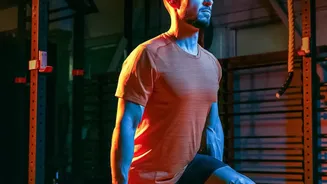
Want stronger, more defined thighs? The journey often begins with two classic moves: squats and lunges. But what makes them so effective, and how do they differ? Let's break down the science behind these foundational exercises for leg strength.
The Squat: A Foundation for Power
Often called
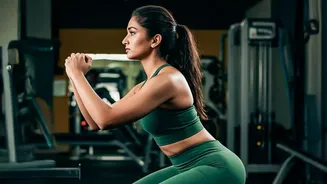
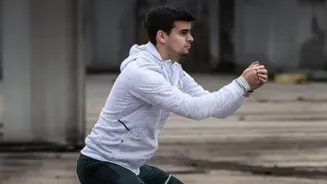
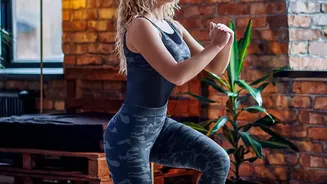
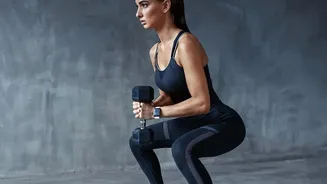
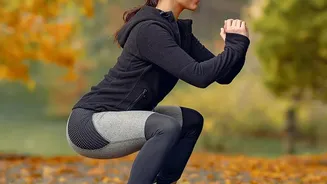
the 'king of exercises', the squat is a fundamental human movement that builds incredible lower-body power. It's a bilateral exercise, meaning it works both legs simultaneously. This stability allows you to lift heavier weights compared to many other leg exercises, which is a key driver for muscle growth and maximal strength development. Squats are a compound movement, engaging multiple muscle groups at once. The primary movers are the quadriceps (the front of your thighs) and the glutes (your buttocks). However, the work doesn't stop there. Your hamstrings (back of the thighs), adductors (inner thighs), calves, and core muscles all fire up to stabilize the movement, making it a highly efficient, full-body integrator. This widespread muscle recruitment not only builds size and strength but also improves functional fitness, making everyday activities like sitting, standing, and lifting objects easier and safer.
The Lunge: For Balance and Precision
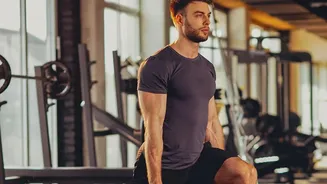
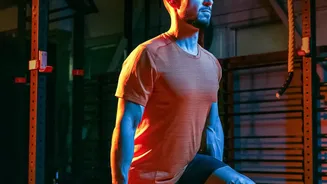
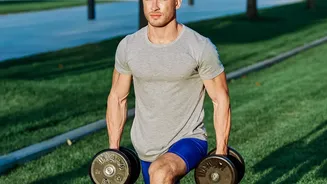
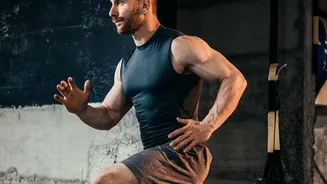
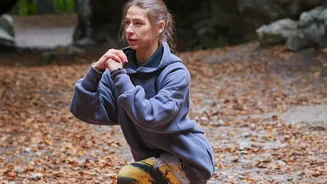
If the squat is about raw power, the lunge is about precision, balance, and stability. As a unilateral exercise, the lunge works one leg at a time. This immediately introduces a balance challenge, forcing smaller stabilizing muscles around your hips, core, and ankles to work overtime. This focus on a single leg makes lunges exceptionally good at identifying and correcting muscle imbalances between your left and right sides, something a bilateral squat might mask. While lunges work the same primary muscles as squats—quads, glutes, and hamstrings—the single-leg focus can stimulate each limb more intensely, a phenomenon known as the bilateral deficit. Furthermore, lunges engage the adductor and abductor muscles of the hip to a greater degree to maintain stability, and different variations can shift the emphasis.
Squat vs. Lunge: Which is Better?
The truth is, neither is inherently 'better'—they are complementary tools for building strong, well-rounded legs. The choice depends on your goal. For building maximal strength and overall muscle mass, the squat is superior because its stability allows for heavier loads. It's your go-to for developing raw power. Lunges, on the other hand, are invaluable for improving single-leg stability, coordination, and ironing out strength asymmetries. This has direct functional carryover to activities like running, climbing stairs, and most sports, which often involve movement on one leg at a time. Many effective training programs don't choose one over the other; they integrate both. You might use heavy squats to build a powerful foundation and use lunges as an accessory exercise to ensure that strength is balanced and functional.
Perfecting Your Form to Prevent Injury
Proper form is non-negotiable for both safety and effectiveness. For a bodyweight squat, stand with your feet shoulder-width apart, toes pointing slightly forward. Sit back as if aiming for a chair, keeping your chest up and your back neutral. Lower yourself until your thighs are at least parallel to the floor, ensuring your knees track in line with your toes and don't collapse inward. Push through your heels to return to the start. For a forward lunge, step one foot forward and lower your hips until both knees are bent at approximately a 90-degree angle. Crucially, your front knee should not travel past your toes, and your back knee should hover just above the ground. Keep your torso upright and core engaged. Push off the front heel to return to the starting position.