




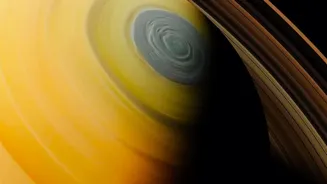
A Crown of Ice and Rock
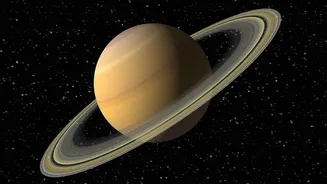
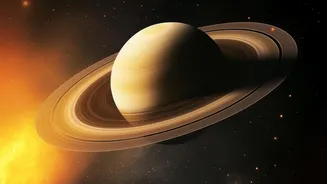
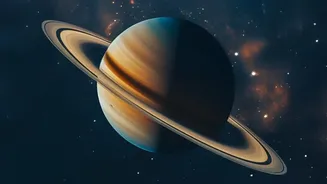
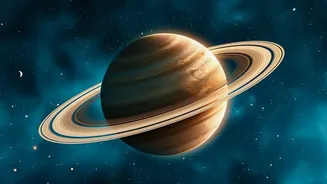
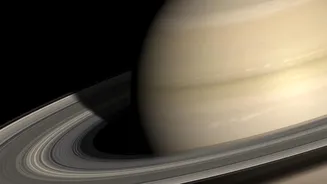
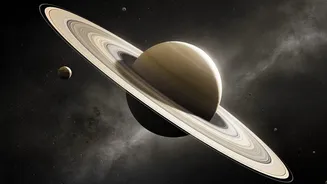
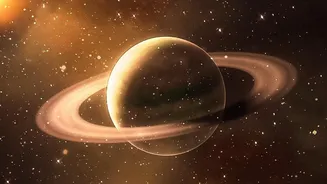
From Earth, Saturn's rings appear as a solid, serene disk. But up close, they are a breathtakingly complex and dynamic system. Comprised of countless individual particles of almost pure water ice, with a small fraction of rocky material, these chunks
range in size from tiny grains of sand to objects as large as mountains. This colossal structure stretches up to 282,000 kilometres across, yet is astonishingly thin, with a typical thickness of only about 10 meters. For over 400 years, since Galileo first mistook them for planetary “handles,” we have marvelled at their scale. Yet, the central question remains a point of intense scientific debate: are these rings a recent addition to the solar system, or are they as ancient as Saturn itself?
Theory One: A Young and Violent Birth
One of the two leading theories posits that Saturn’s rings are relatively young, astronomically speaking. Evidence gathered by NASA’s Cassini spacecraft, which studied Saturn for 13 years, suggests the rings may be no more than 100 to 400 million years old. This would mean they formed when dinosaurs still roamed the Earth, long after Saturn itself came into being 4.5 billion years ago. Proponents of this “late formation” theory argue that the rings’ bright, pristine iciness is a dead giveaway. They contend that if the rings were billions of years old, they would have been significantly darkened and polluted by a constant bombardment of rocky micrometeoroids. So, if they are young, how did they form? The most dramatic scenario involves a cosmic catastrophe. One hypothesis suggests that a large comet or an icy moon strayed too close to Saturn and was ripped apart by the planet’s immense gravitational pull. An even more specific version of this theory has given the hypothetical lost moon a name: Chrysalis. According to simulations, this moon may have orbited Saturn for billions of years before its orbit became unstable, leading to its demise about 160 million years ago. The moon's icy mantle would have shattered to form the rings, while its rocky core plummeted into the planet—a process that would neatly explain both the rings’ icy composition and Saturn's unusual 27-degree axial tilt.
Theory Two: An Ancient, Primordial Relic
The opposing camp argues that the rings are primordial, having formed alongside Saturn 4.5 billion years ago from the same swirling cloud of gas and dust that created the planet. For a long time, this was the default assumption, but it fell out of favour as evidence for the rings' youth mounted. However, recent studies are breathing new life into the ancient origin story. The key is finding a way to explain how old rings could still look so clean. A 2024 study proposed a “self-cleaning” mechanism, suggesting that when micrometeoroids strike the ice particles, they vaporize, and the resulting residue is efficiently swept away into space or towards the planet, keeping the rings perpetually spotless. If this is true, their bright appearance is not an indicator of age. Furthermore, some scientists argue that the rings' current mass and the way they are slowly spreading are perfectly consistent with a very massive ring system that has been evolving for billions of years. In this view, the rings were once much larger and have been gradually losing material—some of which falls onto the planet as a “ring rain,” while material at the outer edge coalesced to form some of Saturn’s inner moons.
The Deciding Clues from Cassini
Much of this debate hinges on data from the Cassini mission, particularly from its 'Grand Finale' in 2017 when the probe made daring dives between the planet and its rings. Cassini’s measurements of the micrometeoroid influx provided a rate of “pollution,” allowing scientists to calculate how long it would take for the rings to get “dirty.” This calculation led to the young-age estimate of 100-400 million years. The spacecraft also directly measured the rate at which ring material is raining down onto Saturn, finding that tons of material are lost every second. This suggests the rings are in a state of rapid decay and will likely disappear in another few hundred million years—strengthening the case that they cannot be ancient. However, other interpretations of the same data keep the debate open. Some researchers believe the ring mass is actually much greater than what Cassini’s measurements implied, which would allow them to survive for billions of years. They argue that the ice particles clump together in dense strands, hiding the true mass from view and making the rings appear younger and less substantial than they really are.