







K2-18b: The Hopeful 'Hycean' World
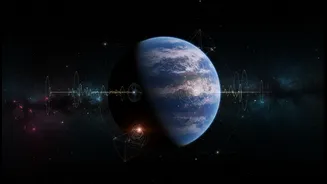
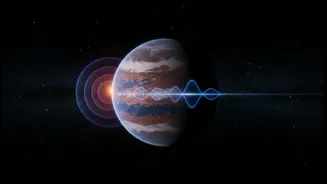
Located about 124 light-years away, K2-18b captured the world's imagination. It's a type of planet known as a sub-Neptune, significantly larger and more massive than Earth, orbiting within its star's habitable zone. This is the region where conditions
could be right for liquid water to exist. Previous observations from the James Webb Space Telescope (JWST) detected carbon-based molecules, suggesting K2-18b could be a 'Hycean' world—a theoretical type of planet with a global water ocean under a hydrogen-rich atmosphere. This made it a prime target in the search for life. The excitement peaked when scientists reported tentative evidence of dimethyl sulfide (DMS), a gas that, on Earth, is overwhelmingly produced by marine life like phytoplankton.
The Problem with 'False Positives'
In astrobiology, a 'biosignature' is a substance or feature that could indicate the presence of life. However, the biggest challenge is avoiding 'false positives'—things that look like a sign of life but are actually produced by non-biological processes. Oxygen, for example, was once considered a sure-fire sign of life, but scientists now know it can be produced abiotically by intense starlight breaking down water molecules. The DMS signal from K2-18b was thrilling but came with a major caveat. Even the original research team noted the need for caution, as unknown chemical processes on a radically different world could mimic a biosignature. Subsequent studies have even suggested that DMS can be formed abiotically, or without life, under certain conditions.
A New Kind of Search
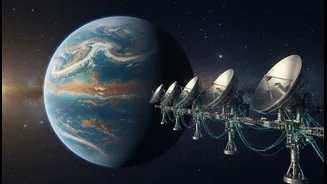
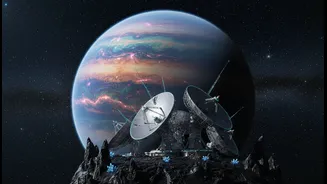
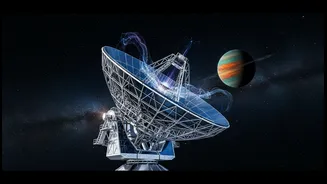
This brings us to the latest research, a massive new survey targeting K2-18b. But instead of looking for atmospheric gases with JWST, scientists conducted a powerful radio survey as part of the Search for Extraterrestrial Intelligence (SETI). They used two of the world's most powerful radio telescope arrays, the Very Large Array (VLA) in New Mexico and MeerKAT in South Africa, to listen for 'technosignatures'. These are signals, specifically narrowband radio transmissions, that would indicate the presence of technology comparable to our own—a very different kind of life signal than a biosignature gas. The goal was to scan for any artificial transmissions coming from the direction of the promising exoplanet.
What the Radio Survey Found
After meticulously analyzing millions of potential signals and using advanced software to filter out interference from Earth and other cosmic noise, the result was clear: silence. The survey found no convincing evidence of artificial radio transmissions from K2-18b. This might sound like a disappointing result, but it serves a vital scientific purpose. It allows astronomers to place an 'upper bound' on the strength of any potential radio transmitter in that system, concluding that nothing as powerful as Earth's own past radio observatories, like the Arecibo dish, appears to be active there. This result effectively filters out one type of life false positive—the idea that the ambiguous atmospheric data might be complemented by a technological signal we just weren't hearing.
Why This Is Good News for Science
Finding no alien radio signals from K2-18b isn't a failure; it's a critical step in refining the scientific method. The project demonstrated a new, highly effective way to conduct SETI searches, making future listening campaigns faster and more efficient. The story of K2-18b shows how science self-corrects and builds on itself. The initial, exciting JWST hints of DMS led to intense scrutiny, debate, and further observation. While several groups now dispute the original DMS detection, the debate itself has been invaluable. This new radio survey adds another layer of data, ruling out intelligent broadcasts and allowing the focus to return to understanding the planet's fundamental chemistry. Each null result helps us fine-tune our methods and manage expectations, ensuring that when a truly convincing signal does arrive, we can be much more confident that it's the real deal.