






The Science of Living Roads
The concept of a road that can automatically repair itself sounds like science fiction, but it's rooted in biology and smart materials science. The most promising technology involves embedding tiny, harmless bacteria into the asphalt or concrete mix.
Specific strains, such as Sporosarcina pasteurii, are chosen for their ability to survive in the alkaline environment of concrete and remain dormant for decades. These microorganisms are packed along with a food source, like calcium lactate, inside tiny capsules. They lie asleep within the road structure, waiting for a specific trigger to begin their work. This approach turns a standard, inert road into a 'living' material capable of regeneration.
How a Pothole Heals Itself
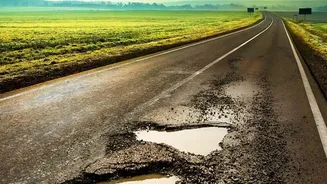
The process is ingeniously simple. When a micro-crack forms in the road surface, rainwater—the very culprit that usually worsens the damage—seeps in. This water acts as a wake-up call for the dormant bacteria. Once activated by moisture, the microbes consume their packed food source. This metabolic process results in the production of calcium carbonate, which is essentially limestone. This limestone deposit naturally fills the crack, hardening to bond the surfaces back together. In essence, the bacteria 'poop out' a substance that seals the fissure, restoring the road's structural integrity and preventing a small crack from evolving into a hazardous pothole. The very element that destroys conventional roads becomes the key to healing for these bio-engineered ones.
Trials and Innovations Across India
While large-scale deployment across major cities is still in its early stages, the potential of self-healing technology has not gone unnoticed in India. Research institutes like CRRI and IIT-Madras are actively experimenting with variants suited for India's tropical climate and heavy traffic loads. There have been successful pilot projects, such as one near Bengaluru in a village called Thondebavi, which used a fiber-reinforced concrete that could self-heal by absorbing water. More recently, engineering students in Shegaon, Maharashtra, developed a bio-self-healing coating, drawing inspiration from similar projects in the Netherlands, and tested it locally. The National Highways Authority of India (NHAI) is also exploring advanced solutions, including asphalt mixed with steel fibres that can be heated to reseal cracks, showing a clear intent to move towards more durable road maintenance technologies.
Beyond a Smoother Commute
The benefits of self-healing roads extend far beyond just preventing the annual monsoon pothole menace. By autonomously repairing micro-cracks, these materials can significantly extend the lifespan of a road, potentially by 30-50%. This translates into massive long-term savings for municipal corporations and taxpayers, as the need for constant, disruptive, and costly patchwork is drastically reduced. Fewer repairs mean less traffic disruption and fewer carbon emissions from maintenance vehicles and asphalt production plants. In Delhi, authorities are already partnering with CSIR-CRRI to test innovative repair technologies, including one using steel slag, highlighting a nationwide push towards more sustainable and cost-effective infrastructure management.
The Road Ahead: Challenges and Potential
Despite the immense promise, the path to widespread adoption has its own set of bumps. The initial cost of self-healing asphalt can be higher than conventional materials, which could be a hurdle for budget-strained civic bodies. Further research is needed to ensure these technologies can withstand the uniquely heavy loads and extreme weather conditions found on many Indian roads. However, the long-term economic argument is compelling; reduced maintenance costs over a road's extended lifespan could save governments significant money. As India continues its ambitious infrastructure expansion under missions like Bharatmala, integrating such smart materials could shift road maintenance from a reactive, endless cycle of repairs to a proactive, resilient, and sustainable model for the future.