





Consider the Source of the Claim
The first stop in any verification process is the source itself. Is the news coming from a peer-reviewed scientific journal like Nature or Science? Is it being reported by a major university, a reputable museum, or a well-known scientific institution?
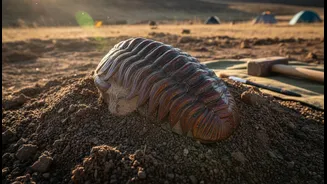
These organizations have rigorous vetting processes. A recent, real discovery of soft tissue in a 450-million-year-old crinoid, for instance, was announced by the University of Oklahoma and published in a scientific journal. In contrast, if the 'discovery' is only circulating on unverified social media accounts, WhatsApp forwards, or personal blogs without any links to primary scientific work, your skepticism should be high. Extraordinary claims require extraordinary evidence, and that evidence usually begins with a credible institution.
Look for the Experts and Their Affiliations
A genuine fossil discovery will always involve paleontologists and geologists. Look for their names in the reporting. Are they quoted directly? What are their credentials? A quick search should tell you if they are affiliated with a university, museum, or research institute. For example, reports on Ordovician and Silurian trace fossils in the Spiti Himalaya name the researchers and their affiliations, such as Panjab University and the Czech Academy of Sciences. If the story lacks named experts or the quoted 'experts' have no verifiable background in paleontology or geology, it’s a significant red flag. Science is a collaborative field built on reputation and expertise; real discoveries will always have real, identifiable experts attached.
Question the Context: Location, Location, Location
Paleontologists often say the context of a find is as important as the fossil itself. The geological setting provides crucial clues to a fossil's age and authenticity. A 450-million-year-old fossil would belong to the Ordovician period. For the claim to be plausible, the fossil must be found in rock layers of that specific age. For instance, recent studies in India have identified Ordovician-era rocks and microfossils in specific locations like the Himalayas. If a supposed ancient fossil is found in a region with much younger geology, or in a context that doesn't make sense (like on a surface that has been exposed for years), it warrants suspicion. As was the case in 2023, when a sensational 500-million-year-old 'fossil' find in India's Bhimbetka Rock Shelters was later identified as the remains of a recent beehive.
Is It a Fossil or Just a Rock?
Our brains are wired to see patterns, a phenomenon called pareidolia. It’s why we see faces in clouds or shapes in random textures. Many 'fossils' found by amateurs are actually suggestively shaped rocks or mineral formations known as pseudofossils. So, how to tell the difference? Real fossils often show specific, complex structures that are not random, like the fine details of a bone's cellular structure or the intricate pattern of a shell. They may also feel different—fossilized bone is often denser than regular rock. In contrast, things that are just 'fossil-shaped' often lack these fine, biological details. If the images are blurry or don't show clear, verifiable biological features, it could just be a trick of light and shadow.
Beware of Hoaxes and Forgeries
The history of paleontology has its share of famous hoaxes, sometimes driven by money or fame. One of the most significant in India was the 'Himalayan fossil hoax,' where a geologist for decades published fraudulent data based on fossils acquired from other parts of the world. These fakes can be composites of different animals, artificially aged materials, or even just carvings on rock. Modern forgeries can be incredibly sophisticated. Scientists use a variety of techniques to spot them, including microscopic analysis, CT scans, and chemical analysis of the surrounding rock matrix. For the average person, a key warning sign is a story that seems too perfect or a seller who cannot provide detailed documentation about where and how the fossil was discovered.