




A New Post from the Cosmic Dawn
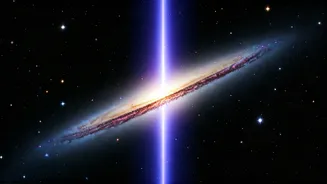
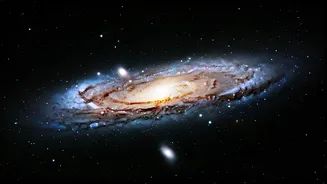
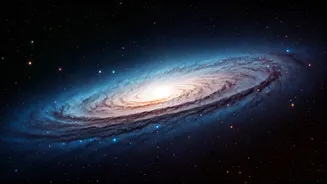
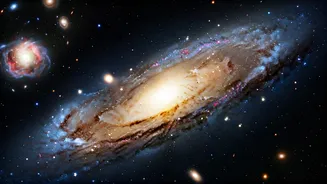
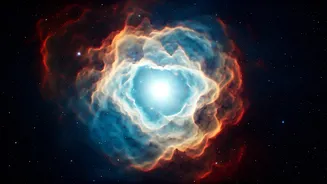
The latest mind-bending dispatch from deep space has a name: JADES-GS-z14-0. It's a galaxy, but not just any galaxy. This is one of the most distant and therefore earliest galaxies humanity has ever seen. Its light has traveled for over 13.5 billion years
to reach us, offering a glimpse of the cosmos as it was just 290 million years after the Big Bang. At that time, the universe was only about 2% of its current age. This discovery, made by an international team using the James Webb Space Telescope (JWST), pushes the frontier of observation deeper into the era known as the Cosmic Dawn, the period when the very first stars and galaxies were switching on.
The Ultimate Time Machine
Seeing something so ancient isn't easy. It requires a specific piece of revolutionary technology. The JWST is the most powerful space telescope ever built, an engineering marvel designed to see the universe in infrared light. This is crucial because, as the universe expands, light from the most distant objects gets stretched out, shifting from visible and ultraviolet light into the infrared spectrum—a phenomenon called 'redshift'. The JWST's giant mirror and sensitive instruments are perfectly tuned to capture this faint, ancient glow, which is invisible to the human eye and even to telescopes like Hubble. It allows astronomers to effectively look back in time, spotting galaxies not as they are today, but as they were billions of years ago.
More Than Just Old
The record-breaking distance isn't even the most shocking part of the story. The big surprise with JADES-GS-z14-0 is how incredibly bright and large it is. Spanning about 1,600 light-years, it's far more luminous than theories predicted for a galaxy this early in cosmic history. Scientists expected the first galaxies to be small, faint proto-galaxies. Instead, JADES-GS-z14-0 is a heavyweight, with a mass already hundreds of millions of times that of our sun, powered by the light of young stars. This discovery challenges our fundamental models of galaxy formation. The big question astronomers are now asking is: how could nature create something so big, so bright, and so massive in less than 300 million years?
Rewriting the First Chapter
Every new discovery from the JWST seems to add another wrinkle to our understanding of the early universe. The existence of a galaxy like JADES-GS-z14-0 suggests that the process of galaxy formation was perhaps more efficient or happened much faster than previously thought. Furthermore, analysis shows the presence of oxygen, an element forged inside stars. Finding it this early is another surprise, suggesting that multiple generations of massive stars must have already lived and died within the first 290 million years. These findings are forcing scientists back to the drawing board, compelling them to refine theories about how the first stars ignited and how the first galaxies assembled themselves from the primordial gas of the early cosmos.