




The Milky Way may contain over 10 million black holes, yet we have found fewer than 100. Closing this gap is a monumental task, not because of a lack of will, but a deluge of data. Now, a novel initiative is recruiting a global army of volunteers.
A Universe of Data
Modern
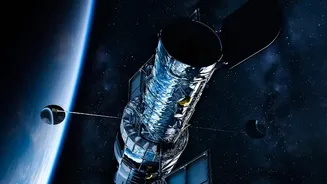
astronomy is a victim of its own success. Telescopes like NASA’s Transiting Exoplanet Survey Satellite (TESS) scan the cosmos with incredible precision, generating immense volumes of data every single day. While these surveys are designed to find planets, they capture information on hundreds of thousands of stars, creating a cosmic haystack of unprecedented size. Somewhere within these terabytes of data are the faint, tell-tale signatures of 'quiet' black holes—those not actively feeding on nearby matter and thus not glowing with X-rays. For a small team of professional astronomers, manually sifting through this mountain of information to find these subtle clues is a practical impossibility.
Recruiting a Global Army
Enter the Black Hole Hunters initiative, a citizen science project hosted on the Zooniverse platform. Led by researchers from institutions like the University of Southampton, the project turns a logistical nightmare into a collaborative triumph. The concept is simple yet powerful: distribute the monumental task of data analysis to thousands of volunteers around the world. These citizen scientists require no formal background in astronomy. The project's goal is to find black holes in binary systems—where a black hole orbits a companion star. By combining the judgments of many volunteers, the project can reliably identify promising candidates for further study.
Training the Citizen Eye
So, what does a black hole hunter actually do? Volunteers are shown 'light curves'—graphs that plot a star's brightness over time, captured by the TESS satellite. They are looking for a specific, rare event called 'gravitational self-lensing'. If a black hole in a binary system passes between its companion star and Earth, its immense gravity acts like a magnifying glass, briefly and symmetrically making the star appear brighter. Volunteers are presented with these light curves and asked to identify whether they see a clear, symmetrical peak that stands out from the background noise. To help them know what to look for, the project provides tutorials and simulated examples of what a true lensing event might look like.
The Human Advantage
In an age of advanced AI, it may seem counterintuitive to rely on human eyes. While automated algorithms do perform an initial sweep to filter the millions of stars down to the most likely candidates, they struggle with the messy reality of cosmic data. Stellar flares, the natural pulsation of stars, and instrument noise can easily trick an algorithm into flagging a false positive. Humans, on the other hand, possess a remarkable talent for pattern recognition that can distinguish a true, clean signal from misleading noise. AI trained on imperfect simulations can miss real signals, making the collective intelligence of thousands of human volunteers an indispensable tool for verification. This human-in-the-loop approach ensures that astronomers’ valuable time is spent on the most promising leads.
First Light for the Project
The Black Hole Hunters project is already making significant progress. Since its launch, nearly 23,000 volunteers have made almost 12 million classifications. An earlier phase of the project used data from the SuperWASP survey, and results from that effort are expected to be published soon. The current phase, using higherer quality data from TESS, is expected to yield dozens, or perhaps even hundreds, of new black hole candidates. Each candidate flagged by multiple volunteers represents a target for professional astronomers, who can then use powerful ground -based telescopes for follow -up observations to confirm the discovery. Each confirmed find will be a historic first, as no conclusive example of self -lensing by a black hole has been found to date.