



The Lifeboat in a Lightning Storm
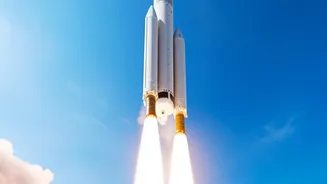
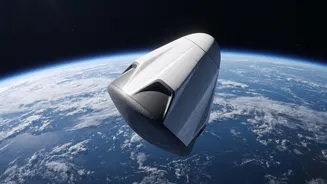
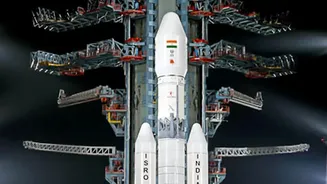
Imagine a catastrophic failure during launch. The rocket is climbing at supersonic speeds, and something goes wrong. The astronauts' only hope is the Crew Escape System (CES), a dedicated rocket designed to pull their capsule—the Crew Module—away from
the malfunctioning launcher. This system must work perfectly in seconds. It ign時間tes powerful motors to blast the module clear, subjecting it to immense forces. But simply getting away isn't enough. The module, now flying on its own, must not tumble uncontrollably. It needs to maintain what engineers call 'aerodynamic stability'—the ability to fly predictably and safely, even as it punches through the atmosphere at speeds faster than sound.
Building a Digital Twin
Before any metal is cut or hardware tested, the entire escape scenario is built in a virtual world. ISRO's engineers use a powerful tool called Computational Fluid Dynamics (CFD). This involves using supercomputers to run complex simulations that model the flow of air around the crew module during a high-speed abort. Tens of thousands of data points are analyzed, showing how pressure, velocity, and temperature will affect the module. These digital tests allow engineers to experiment with different shapes and designs for the module and its escape system, tweaking them to find the most stable configuration. CFD can simulate conditions that are difficult or expensive to recreate in the real world, providing a foundational understanding of the vehicle's aerodynamic behavior.
Harnessing the Wind
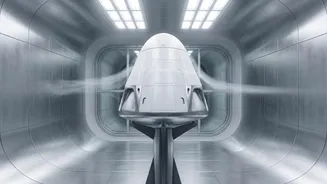
While computer simulations are incredibly powerful, they are based on mathematical models. To ensure these models are accurate, ISRO turns to physical testing in wind tunnels. Precisely scaled-down models of the Gaganyaan crew module are placed inside these tunnels, where powerful fans generate winds that replicate various flight conditions, from subsonic to supersonic speeds. Specialised instruments, such as strain gauges, measure the forces and torques acting on the model. This provides real-world data on the module's stability. By rotating the model and changing the wind speed, engineers can validate the predictions made by their CFD simulations and fine-tune the aerodynamic design. This crucial step helps confirm that the module will behave as expected during its frantic, life-saving journey.
From Virtual to Reality: The Test Flights
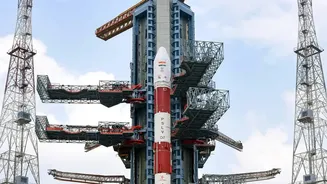
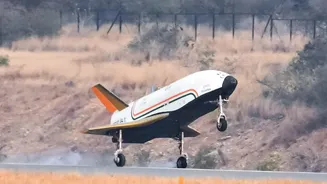
The data from CFD and wind tunnels provides the confidence to proceed with real-world, full-scale tests. These are the ultimate proof of the system's design. ISRO has conducted several crucial test flights, known as Test Vehicle Abort Missions. In these tests, a specially designed rocket carries a full-sized, unpressurised version of the crew module to a specific altitude and speed. For instance, in the TV-D1 mission, the escape was triggered at Mach 1.2—a critical transonic phase. The Crew Escape System then fires, pulling the module away from the test rocket. Onboard sensors record every detail of the flight, from the module's orientation and stability to the successful deployment of parachutes for a safe splashdown. These tests prove that the entire sequence, meticulously analyzed in simulations and tunnels, works in practice.
A Symphony of Safety
Analyzing aerodynamic stability isn't a single step but a continuous, multi-layered process. It begins with theoretical calculations, moves to sophisticated computer simulations, is validated by physical wind tunnel experiments, and culminates in high-stakes test flights. Each stage informs and refines the next. Fins may be added to the escape system to provide stability, much like the feathers on an arrow. The distribution of mass within the crew module is carefully managed. Every element of the design is scrutinized to ensure that when the escape motors fire, the module orients itself correctly for a safe descent and splashdown. This exhaustive analysis is a testament to ISRO's commitment to making astronaut safety the absolute bedrock of the Gaganyaan program.