



An Icon's Enduring Legacy
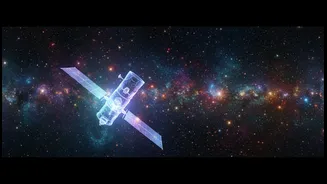
Launched in 1990, the Hubble Space Telescope revolutionised our understanding of the universe. Orbiting above Earth's distorting atmosphere, it delivered images of breathtaking beauty and unprecedented scientific value. It helped determine the age of the universe,
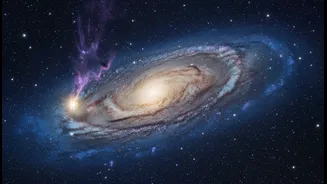
discovered moons around Pluto, and provided evidence for supermassive black holes at the centres of galaxies. For a generation, the name 'Hubble' became synonymous with space itself. But with the launch of the more powerful James Webb Space Telescope (JWST), many wondered if Hubble’s celebrated mission was drawing to a close. However, to write off Hubble would be a mistake. Thanks to human ingenuity, the seasoned telescope is tackling some of astronomy's oldest and most stubborn problems in a completely new way.
The Puzzle of the Globular Clusters
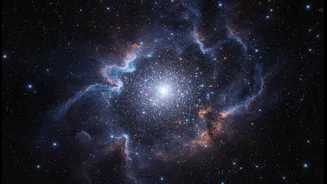
One of the most persistent mysteries in astronomy concerns the growth of galaxies. We see vast, majestic spiral and elliptical galaxies today, but how did they get that way? A key piece of this puzzle lies with globular clusters. These are ancient, tightly packed, spherical collections of hundreds of thousands, or even millions, of stars. Most galaxies, including our own Milky Way, have these clusters orbiting them like satellites. Since the stars in a globular cluster all formed at roughly the same time from the same material, they should be chemically identical. But they aren't. For decades, astronomers have been baffled to find multiple, distinct populations of stars within a single cluster, suggesting a more complex birth story than previously imagined. This mystery of 'multiple populations' holds fundamental clues about how the first 'seed' structures in the universe formed and grew into the massive galaxies we see today.
A New Pair of Eyes
Solving this mystery requires seeing the unseeable. The stars in a globular cluster are so densely packed that from our perspective, they blur into a single mass of light. Even for Hubble, distinguishing individual stars in a cluster's core is incredibly challenging. This is where new high-resolution imaging techniques come in. Rather than a new piece of hardware, this 'revival' is powered by sophisticated software and clever observing strategies. By combining multiple images taken over many years—sometimes called 'drizzle' techniques—astronomers can use complex algorithms to reconstruct a much sharper, deeper view than any single exposure could provide. These methods effectively increase Hubble's resolving power, allowing it to dive into the crowded hearts of these clusters and separate the light from individual stars that are incredibly close together. It's like giving an old camera a brand-new lens through pure software genius.
Cracking the Cosmic Code
Armed with these ultra-sharp images, astronomers can now perform a stellar census with incredible precision. They can count the stars, measure their brightness, colours, and—crucially—their chemical compositions. By analysing the light from individual stars, they can identify the different 'generations' of stars within the cluster and map their locations. This detailed information allows scientists to build and test models of how these clusters formed. For example, did a second generation of stars form from gas polluted by the first? Did the cluster form from the merger of smaller clusters? A recent study celebrating the US 250th anniversary highlighted a stunning new Hubble portrait of Messier 3, a cluster containing over 500,000 stars, whose unusual population is helping unravel the Milky Way's past. By answering these questions for many different globular clusters, astronomers can piece together a timeline of the chaotic early universe and understand the processes that built the first galaxies.
Hubble's Role in a New Era
This work beautifully demonstrates that Hubble’s mission is far from over; it’s evolving. While the JWST peers deeper into infrared wavelengths to see the very earliest moments of the universe, Hubble continues to provide a unique and essential view in visible and ultraviolet light. The two telescopes are not rivals, but partners. In fact, a recent Hubble observation found a galaxy from the early universe blazing with ultraviolet light, a discovery thought impossible until recently, which helps explain how the cosmos cleared of an early 'fog' of neutral hydrogen. The ability to use new software and AI-assisted methods to mine decades of archival data means Hubble is, in a sense, a new telescope every day. It remains a critical tool, not just for making new discoveries but for adding crucial context to the findings of newer observatories. The revival of Hubble is a powerful lesson in how scientific progress is often about not just new tools, but finding new ways to use the ones we already have.