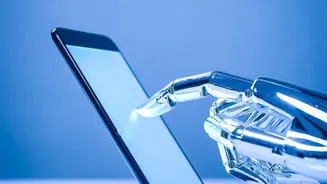








Your New Job Search Co-Pilot
Think of AI writing assistants like ChatGPT, Claude, or Gemini as a co-pilot for your job application process. Their main strength lies in automating the repetitive, time-consuming parts of applying for jobs. Instead of staring at a blank page, you can
generate a solid first draft of a cover letter or resume in seconds. These tools can analyze job descriptions to identify crucial keywords and suggest ways to structure your documents, giving you a strong foundation to build upon. This efficiency is a game-changer, freeing up your time to focus on networking and interview preparation—the human elements that truly secure a job offer.
Achieve Flawless Professionalism
Even a small typo can create a poor first impression. AI assistants excel at catching grammatical errors and awkward phrasing, ensuring your application is clean, professional, and easy to read. This is particularly useful for polishing your writing and presenting your thoughts clearly. Beyond just grammar, these tools can help you adopt a more professional tone, suggesting stronger verbs and more confident language to describe your accomplishments. The goal is to ensure that the quality of your writing matches the quality of your experience, leaving no room for distraction.
Tailor Every Application at Scale
One of the most critical aspects of a successful job hunt is tailoring your resume and cover letter for each specific role. Manually doing this is tedious, but AI makes it significantly easier. By feeding an AI tool the job description and your master resume, you can quickly get suggestions on which skills to highlight and what keywords to include. This helps your application get past the initial screening by Applicant Tracking Systems (ATS), which many companies use to filter candidates. With AI's help, you can efficiently customize your pitch for dozens of roles, dramatically increasing your chances of landing an interview.
The Human Touch is Irreplaceable
While AI is a powerful assistant, it is not a replacement for your own effort and voice. Recruiters are becoming adept at spotting generic, robotic-sounding applications, which are often rejected. In a recent survey, 62% of HR professionals said they reject AI-generated resumes that lack personalization. The content AI produces can be impersonal, lack emotional intelligence, and sometimes even contain factual errors or 'hallucinations'. Your application must reflect your unique personality, motivations, and specific achievements. Use AI to generate a first draft, but always revise it heavily to inject your own voice and ensure every detail is accurate.
How Recruiters View AI-Assisted Applications
In the Indian context, where recruiters face a high volume of applications, AI is a double-edged sword. While many recruiters use AI themselves to screen candidates, over half also point to a surge in low-quality, AI-generated applications as a major challenge. The key is to use AI thoughtfully. Recruiters appreciate applications that are well-tailored, but they can easily spot when a candidate has simply copied and pasted without adding personal insight. Your goal is to use AI to enhance your story, not to create a generic one. An application that demonstrates specific, quantifiable achievements will always stand out more than a perfectly worded but soulless document.