






Why Our Cities Are Getting Hotter
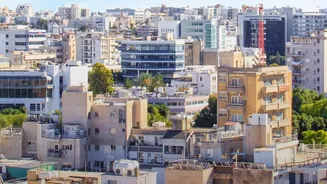
It’s not your imagination; our cities are becoming significantly hotter. This phenomenon, known as the Urban Heat Island effect, is a major concern across India. Metros like Delhi, Mumbai, and Chennai often record temperatures 5 to 8 degrees Celsius higher
than surrounding rural areas. The reason is simple: our cities are vast expanses of concrete, asphalt, and dark-coloured materials that are incredibly efficient at absorbing and radiating the sun's heat. This, combined with less green cover and heat from vehicles and industries, turns our urban environments into virtual ovens, leading to health risks, strained power grids from constant air conditioner use, and a lower quality of life.
A High-Tech Coat of Paint
Enter the world of advanced cooling paints. While painting roofs white to reflect heat is an age-old technique, modern science has taken this concept to a new level. Researchers, notably at institutions like Purdue University, have engineered ultra-white paints that are a leap beyond commercial options. The term "bio-engineered" in the headline points towards paints that are often inspired by natural phenomena or use advanced materials to achieve superior performance, rather than being literally alive. These new formulations are designed not just to reflect sunlight but to actively push heat away from a surface.
The Science of Passive Cooling
So, how does a layer of paint actually cool a building? The magic lies in two key properties: high solar reflectance and high thermal emittance. Firstly, the paint acts like a powerful mirror, reflecting a huge percentage of sunlight—up to 98% in some advanced formulas—before it can be absorbed as heat. Standard paints might reflect 80-90%. Secondly, and more impressively, is the concept of radiative cooling. The paint is engineered to emit any heat it does absorb back into the atmosphere as infrared radiation. This radiation passes through the atmosphere and escapes into the cold of deep space, allowing the painted surface to become cooler than the surrounding air, even in direct sunlight.
What Makes This Paint Special
Unlike standard white paints that primarily use titanium dioxide, these next-generation coatings use compounds like barium sulfate or hexagonal boron nitride. Researchers found that using a variety of particle sizes within the paint scatters a much wider range of the sun's rays. The result is a surface that doesn't just stay neutral, but actively cools down. Tests have shown these surfaces can remain up to 10°C cooler than their ambient surroundings. For a 1,000-square-foot roof, this can provide cooling power equivalent to a typical home air conditioner, but without using a single watt of electricity.
A Solution Made for India
The application for India is immense. With extreme heat waves becoming the norm, a passive, low-cost cooling solution is a necessity, not a luxury. Programs like the India Cooling Action Plan are already promoting passive cooling strategies. In cities like Ahmedabad, Hyderabad, and Chennai, cool roof initiatives are already being implemented to provide relief, especially in low-income housing where air conditioning is unaffordable. Recently, researchers at JNCASR in Bengaluru developed a low-cost radiative cooling paint using an MgO-PVDF polymer, specifically designed for Indian conditions. These efforts show a clear path towards wider adoption, moving from pilot projects to city-wide policy.
Beyond Just Cooling Buildings
The benefits of this technology extend far beyond individual comfort and lower electricity bills. Widespread adoption of cool roofs can significantly mitigate the Urban Heat Island effect on a larger scale, lowering ambient temperatures across entire neighbourhoods. This leads to improved public health, reduced air pollution (as power plants burn less fuel), and a more resilient energy grid less prone to blackouts during peak summer demand. By reflecting sunlight back into space, these surfaces also play a small but direct role in combating global warming, offering a simple yet powerful tool for creating more sustainable and liveable cities.