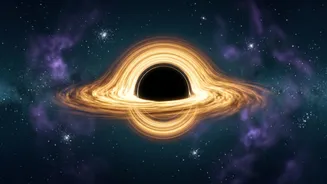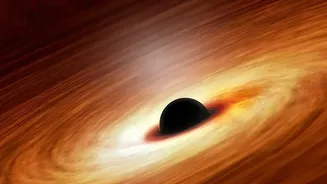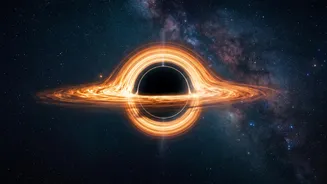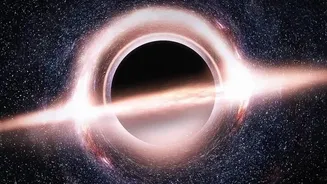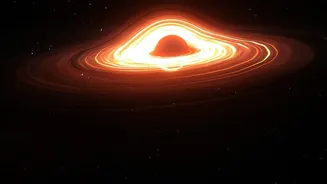




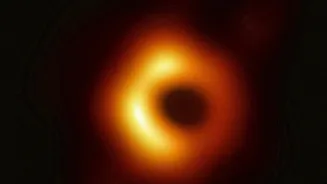

The Milky Way is thought to host 100 million black holes, yet we’ve found fewer than 100. A groundbreaking citizen science project called Black Hole Hunters is changing that, enlisting thousands of volunteers to find these invisible giants.
An Army of Cosmic Detectives
Astronomers
believe our galaxy is teeming with black holes, but since they don't emit light, the vast majority remain hidden. To tackle this cosmic puzzle, researchers from the University of Southampton launched Black Hole Hunters, a project hosted on the Zooniverse platform. It invites anyone with a computer to join the search. Since its launch, nearly 23,000 volunteers have signed up, contributing millions of classifications of star data. This incredible response transforms the lonely work of data analysis into a massive collaborative effort, proving that the public's curiosity for the cosmos is as vast as space itself.
How to Hunt a Black Hole
Volunteers aren't staring into the void; they're looking for a specific clue left by a black hole's immense gravity. The project focuses on binary systems, where a black hole orbits a normal star. As the black hole passes in front of its companion star from our point of view, its gravity bends and magnifies the star's light, causing it to briefly appear brighter. This effect is called 'gravitational self-lensing'. Volunteers are shown graphs of star brightness over time, taken from NASA's Transiting Exoplanet Survey Satellite (TESS), and are asked to identify the distinctive spike pattern that signals a potential black hole.
Why Human Eyes Still Matter
In an age of artificial intelligence, it might seem strange to rely on human volunteers. However, the human brain excels at pattern recognition in ways that algorithms still struggle with. While AI is used to pre-screen the millions of stars observed by the TESS telescope and narrow the candidates down to about one million, it's the volunteers who perform the crucial next step. They sift through these AI-selected candidates to spot the subtle, repeating patterns of self-lensing amidst a sea of other stellar variations. This human-machine partnership is a powerful model for modern science, allowing researchers to analyze massive datasets far more effectively than either could alone.
The Thrill of Discovery
For the volunteers, the project offers more than just a way to pass the time. It’s a chance to make a genuine contribution to astrophysics. No prior expertise is required; the project provides simple examples to train participants on what to look for. As Dr. Adam McMaster, one of the project's co_leads, explained, every participant has the potential to be the very first person to identify a new type of black hole system. This direct involvement in cutting_edge science is a powerful motivator, attracting students and enthusiasts who are excited by the possibility of finding one of the galaxy's hidden giants from their own laptops.
What the Hunt Will Reveal
Finding these dormant black holes is about more than just boosting the numbers. Each new discovery helps astronomers build a more complete census of the black hole population in the Milky Way. This data is vital for testing and refining theories about how massive stars evolve, live, and die. By understanding the number, mass, and distribution of these stellar remnants, scientists can piece together a more accurate history of our galaxy. The list of promising candidates flagged by the Black Hole Hunters will guide future observations with powerful telescopes, ensuring that precious instrument time is used as efficiently as possible to confirm these cosmic specters.