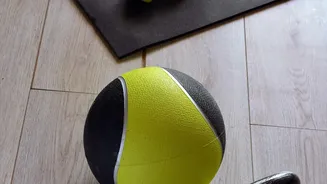







When it comes to fitness, Shilpa Shetty is always finding new ways to keep things interesting. Her latest challenge is no different, trading heavy weights for a playful drill that tests catching skills, balance, and intense concentration.
The Body-and-Brain Workout
In a recent social
media post, Shilpa Shetty demonstrated a seemingly simple yet demanding exercise. It involved standing, sometimes on one leg for an added challenge, while dropping and catching two balls in a continuous, rhythmic motion. This isn't your typical cardio or strength training; it's a functional workout designed to make the body and brain work in unison. The goal is to maintain balance and core control while your hands and eyes are busy with a completely different task. As Shetty explained in her post, this type of drill is all about 'coordination, focus and fun', proving that effective fitness doesn't always have to feel like a grueling chore.
The Science of a Sharper Mind
What looks like a simple catching game is actually a powerful cognitive exercise. Activities that require hand-eye coordination and balance are known to activate multiple areas of the brain simultaneously. This includes motor circuits, memory pathways, and both the right and left hemispheres. Such exercises enhance proprioception, which is your body's awareness of its position in space. By forcing your brain to track moving objects, anticipate their path, and command your muscles to react precisely, you are effectively training your neural pathways. This process can improve mental clarity, increase blood flow to the brain, and support stronger neural connections, ultimately helping to reduce 'brain fog'.
More Than Just Athletic Skill
While quick reflexes and sharp coordination are crucial for athletes, the benefits extend far into everyday life. Good mind-body connection helps with everything from preventing falls to improving posture and simply moving more efficiently. As we age, maintaining these skills becomes vital for preserving cognitive function and independence. Combining physical and mental tasks, as seen in Shilpa's challenge, trains cognitive flexibility—the brain's ability to adapt and respond to changing information. Think of it as multitasking for your nervous system. By making your brain and body communicate effectively under pressure, you are building a more resilient and responsive system that serves you both in and out of the gym.
How to Add Coordination Drills to Your Routine
Inspired by Shilpa's challenge? The good news is that you don't need fancy equipment to start training your coordination. You can begin with a simple tennis ball. Start by tossing it from one hand to the other. To make it harder, try focusing your gaze on a fixed point in front of you instead of watching your hands. Another great exercise is the wall ball drill: stand a few feet from a wall, toss the ball, and catch the rebound. You can increase the difficulty by using your non-dominant hand or standing on one leg. Other activities like 'Cross Crawls', where you touch your right elbow to your left knee and vice versa, also help improve coordination between the brain's hemispheres. The key is to start slow, focus on control, and gradually introduce more complexity as you get comfortable.