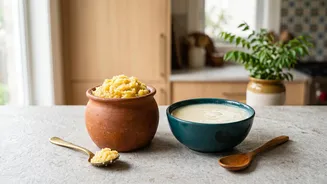







In the landscape of Indian cuisine and wellness, ghee is a constant. But the moment you decide to buy a jar, the eternal question arises: cow ghee or buffalo ghee? The answer involves more than just the source, with key differences in nutrition and use.
The Visual and Textural Cues
The most immediate difference is colour. Cow ghee is typically a vibrant golden yellow, while buffalo ghee is a creamy white. This isn't a sign of purity but of biology. Cows pass beta-carotene from their diet into the milk fat, which gives the ghee its yellow hue. Buffaloes, on the other hand, convert beta-carotene into the colourless Vitamin A more efficiently, resulting in white fat. In terms of texture, cow ghee is often described as having a lighter, more granular (or 'danedar') consistency. Buffalo ghee is denser and smoother, packing together more tightly because of its higher fat content.
A Look at the Nutritional Profile
Both ghees are forms of clarified butter, rich in fat and calories. However, buffalo ghee consistently has a higher fat content and, consequently, more calories than cow ghee. This makes it a source of dense energy, traditionally favoured by those with high physical demands, like athletes or labourers. In contrast, cow ghee is lighter. It contains more fat-soluble vitamins like A, D, and E. While buffalo ghee also contains these nutrients, the concentration in cow ghee, particularly the beta-carotene that converts to Vitamin A, is often highlighted. Some sources also note that cow ghee may contain a higher proportion of polyunsaturated fatty acids.
Digestion and Ayurvedic Wisdom
According to Ayurveda, cow ghee is considered 'sattvic', meaning it promotes harmony and is lighter on the digestive system. It is often recommended for daily consumption, especially for children and the elderly, as it's easier to digest. Buffalo ghee is considered heavier and can be more difficult for those with sensitive stomachs to process. From a doshic perspective, cow ghee is often seen as balancing for all doshas, particularly Pitta due to its cooling properties. Buffalo ghee, being heavier, is sometimes recommended in winter or for those needing to build strength and pacify Vata and Kapha doshas.
Best Uses in the Kitchen
The choice of ghee can significantly impact a dish's final flavour and texture. With its mild, pleasant flavour, cow ghee is ideal for daily cooking, such as spreading on rotis, drizzling over dal and rice, or for general sautéing where you don't want to overpower the other ingredients. Buffalo ghee's rich, strong, and creamy taste makes it the preferred choice for preparing traditional Indian sweets like laddoos and halwa, as well as for deep-frying puris or parathas. Both have high smoke points (around 230-250°C), making them suitable for high-heat cooking, though buffalo ghee's is sometimes noted as slightly higher, making it exceptionally stable for deep frying.
Heart Health and Weight Management
For those managing their weight, cow ghee is generally the recommended option due to its slightly lower calorie count and fat content. Its purported ability to support a healthy metabolism makes it a better fit for weight-conscious individuals. Conversely, buffalo ghee's higher fat density makes it more suitable for those looking to gain weight or build muscle mass. When it comes to heart health, moderation is key for both. However, due to its higher saturated fat content, individuals with cholesterol concerns are often advised to be more cautious with buffalo ghee. Cow ghee is considered a more heart friendly option when consumed in moderation.