



Cosmic Lighthouses
Imagine peering back over 13 billion years to the infancy of the cosmos. It’s a time shrouded in mystery, but astronomers have powerful tools to light up the darkness. The most brilliant of these are quasars. A quasar, short for 'quasi-stellar radio source',
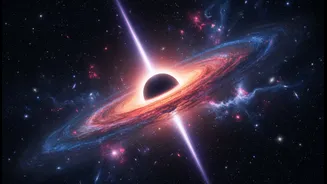
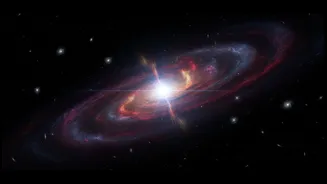
isn't a star at all, but the intensely luminous heart of a distant galaxy. At its center lies a supermassive black hole, millions or even billions of times the mass of our Sun, actively feeding on a surrounding disc of gas and dust. As this material spirals inward, immense friction and gravity heat it to extreme temperatures, causing it to blaze with a light that can outshine its entire host galaxy by thousands of times. This incredible brightness makes them visible across vast stretches of space and time, acting as cosmic lighthouses that illuminate the universe's distant past.
The Early Universe Problem
One of the most persistent puzzles in cosmology is the existence of supermassive black holes so early in the universe's history. Observations have revealed quasars powered by billion-solar-mass black holes when the universe was less than a billion years old. This presents a significant timing problem. How did they get so big, so fast? Standard theories suggest black holes grow by consuming matter or merging with other black holes, but there simply doesn't seem to have been enough time since the Big Bang for these processes to create such behemoths. Scientists have proposed various theories, from massive 'seed' black holes forming directly from the collapse of enormous gas clouds to hyper-efficient feeding frenzies, but the evidence has been hard to gather.
The Brightest Beacons Offer Clues
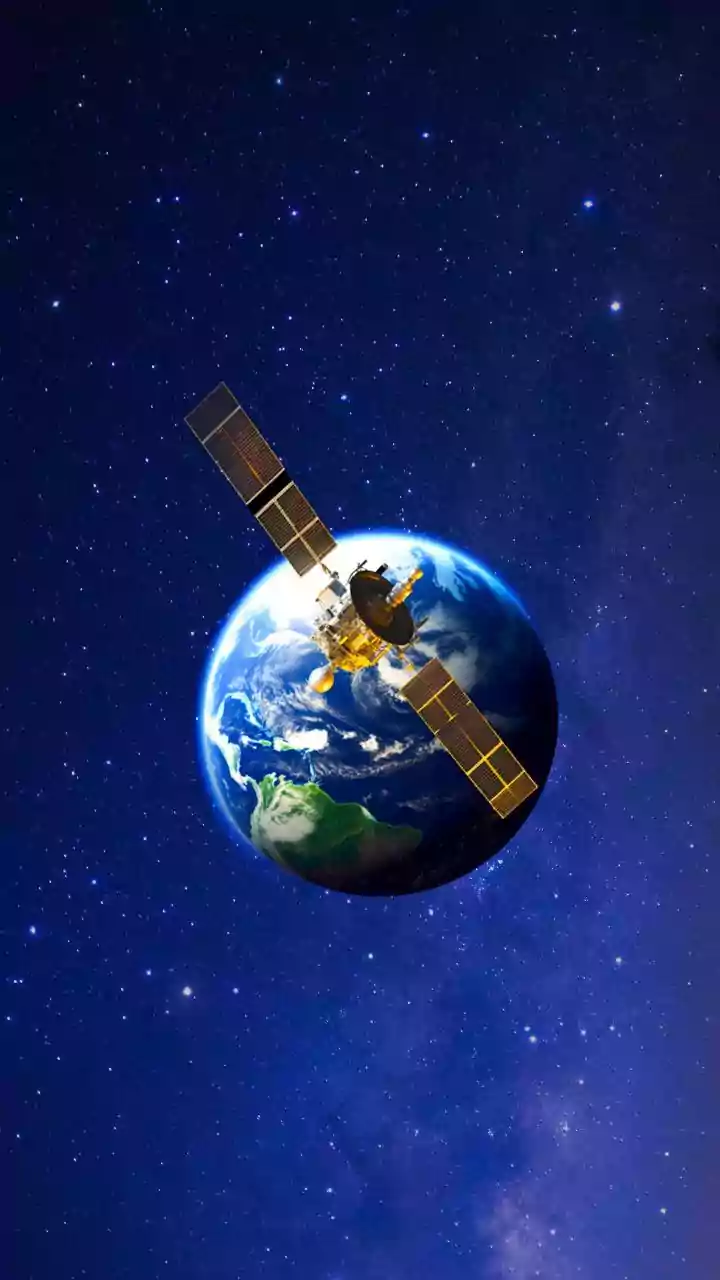
This is where the brightest early quasars come in. Recent discoveries, particularly from powerful new observatories like the Euclid space telescope and the James Webb Space Telescope (JWST), are systematically finding more of these ancient objects. Some of the latest discoveries date back to when the universe was only about 670 million years old, just 5% of its current age. An object's extreme brightness suggests a very massive black hole is powering it, or that it's consuming matter at a furious rate—or both. Discovering these bright quasars in greater numbers allows scientists, for the first time, to study a population of 'typical' early black holes, not just the most extreme outliers. Each new discovery provides a vital data point for understanding how these cosmic giants formed and grew during the universe's formative years.
Reading the Cosmic Environment
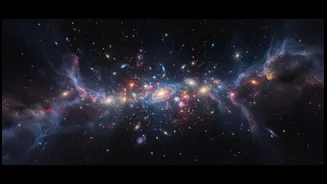
Crucially, a quasar does more than just signal the presence of a massive black hole. The light it emits travels for billions of years to reach our telescopes, and on its journey, it passes through the quasar's own host galaxy and the vast stretches of intergalactic space. This light acts like a cosmic probe. As it passes through clouds of gas, specific elements within those clouds absorb the light at characteristic wavelengths. Astronomers can analyze the quasar's light spectrum to see these absorption lines, providing a chemical fingerprint of the material it traversed. This allows them to deduce the composition, temperature, and density of the 'environment' around the black hole and within its young host galaxy, revealing what raw materials were available for building the first stars and galaxies.
A New Era of Discovery
The technological investment in instruments like the James Webb and Euclid space telescopes is paying huge dividends in this field. JWST, in particular, is a game-changer because its advanced infrared instruments are perfectly tuned to detect the light from these extremely distant objects. Due to the expansion of the universe, the light from early quasars is stretched to longer, redder wavelengths—a phenomenon called redshift. JWST can peer through cosmic dust and capture this redshifted light with unprecedented clarity. This has led to the discovery of previously hidden, dust-shrouded quasars, suggesting that supermassive black holes might be even more common in the early universe than previously thought. These new capabilities allow scientists to test theories about how a quasar’s intense energy output can affect its host galaxy, potentially shutting down star formation by blasting away gas in powerful outflows.