



Flares vs. CMEs: The Sun’s One-Two Punch
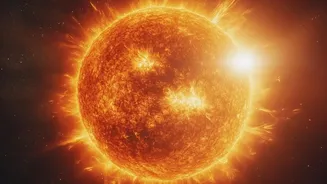
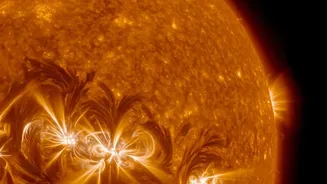
First, it’s important to understand what we’re tracking. Headlines often use the term “solar flare” for any big solar event, but there’s a key distinction. A solar flare is an intense burst of radiation—a brilliant flash of light. Because it travels at the speed
of light, its effects, like radio blackouts, can reach Earth in about eight minutes. However, the truly significant threat to our infrastructure comes from Coronal Mass Ejections, or CMEs. A CME is a massive cloud of magnetised gas, or plasma, that is violently ejected from the Sun’s outer atmosphere, the corona. Think of a flare as the muzzle flash from a cannon, while the CME is the actual cannonball—a billion-tonne projectile of superheated matter traveling millions of kilometres per hour through space. While often linked, flares and CMEs are separate events, and it's the Earth-directed CMEs that scientists are most focused on tracking.
The Challenge of Staring at the Sun
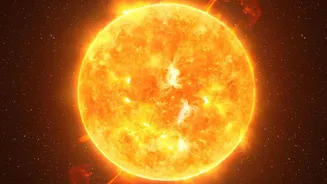
Spotting a CME leaving the Sun is incredibly difficult for a simple reason: the Sun is blindingly bright. Its visible surface, the photosphere, is so luminous that it completely washes out the much fainter light of the corona surrounding it. The corona is about a million times dimmer than the photosphere, which is why we can only see it from Earth with the naked eye during a total solar eclipse, when the Moon perfectly blocks the Sun's disk. To track CMEs, scientists needed a way to create this eclipse effect on demand, without waiting for rare celestial alignments. This challenge led to the invention of a specialised instrument designed to do just that.
The Coronagraph: An Artificial Eclipse
The solution is a device called a coronagraph, first invented by Bernard Lyot in the 1930s. In simple terms, a coronagraph is a telescopic instrument that uses a solid disk, called an occulting disk, to block the direct light from a star. You can simulate this yourself by holding your thumb up to block the bright sun; suddenly, you can see things in the sky nearby that were previously invisible. A coronagraph in a satellite does the same thing, but with far greater precision. The occulting disk is perfectly positioned to cover the Sun's bright face, plunging the telescope's sensor into shadow and allowing the faint, wispy details of the corona to be seen and photographed. This artificial eclipse is the key to seeing CMEs as they erupt and billow outwards from the Sun.
Space-Based Sentinels on Watch
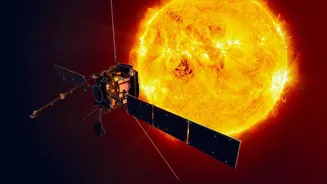
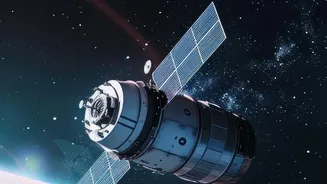
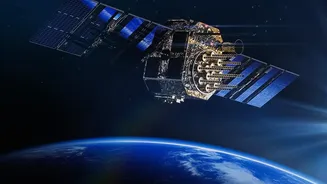
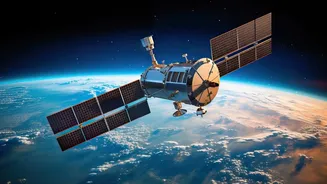
While ground-based coronagraphs exist, they are hampered by the scattering of sunlight in Earth’s own atmosphere. For the clearest view, you need to go to space. Missions like the joint NASA/ESA Solar and Heliospheric Observatory (SOHO) and the STEREO spacecraft have been our primary solar sentinels for years. These satellites are equipped with coronagraphs like LASCO, which have been used to identify tens of thousands of CMEs. By capturing a continuous stream of images, scientists can create time-lapse videos that show a CME bursting from the corona and moving out into space. By analysing these images from different angles (thanks to multiple spacecraft), they can build a 3D model of the eruption, determining its speed, size, and—most importantly—its trajectory.
From Mapping to Warning
Once a CME is spotted and its path is mapped toward Earth, the data becomes a crucial forecast. It can take anywhere from 15 hours to three days for a CME to travel from the Sun to Earth. This advance notice is critical. Forecasters at agencies like NOAA’s Space Weather Prediction Center use the coronagraph data to issue warnings. These alerts give satellite operators time to put their spacecraft into a protective safe mode, allow power grid managers to balance loads to prevent blackouts, and enable airlines to reroute flights away from polar regions where radiation effects are strongest. Essentially, coronagraphs transform a scientific observation into an actionable early warning system, helping to protect the technological backbone of our modern world from the Sun's powerful outbursts.