


Beyond the Goldilocks Zone
For decades, the hunt for life beyond our solar system has focused on the 'habitable zone,' often called the 'Goldilocks zone.' This is the region around a star where conditions are just right—not too hot and not too cold—for liquid water to exist on a planet's
surface. Water is considered a key ingredient for life as we know it. However, scientists now understand that location alone is a poor guarantee of habitability. A planet can be in the perfect orbital spot but remain a barren, lifeless rock. The story of what makes a world truly capable of hosting life is far more complex, involving a cosmic interplay of planetary and stellar characteristics that must all align perfectly.
The Protective Embrace of Air
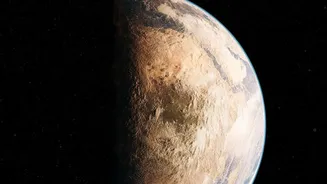
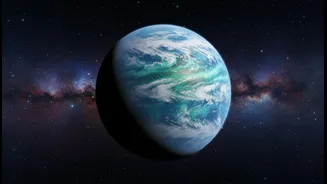
An atmosphere—the 'air' of a planet—is arguably one of the most critical components for life. It does much more than provide gases to breathe. A substantial atmosphere creates the necessary surface pressure to keep water from boiling away into space, regulates temperature through a greenhouse effect, and shields the surface from a star's harmful radiation. Without it, a planet in the habitable zone would face extreme temperature swings and a bombardment of cosmic rays. Using advanced tools like the James Webb Space Telescope, scientists are now able to peer into the atmospheres of distant exoplanets, searching for 'biosignatures'—gases like oxygen, methane, and carbon dioxide that could hint at biological or geological processes. The recent detection of an atmosphere on the rocky exoplanet LHS 1140 b, located in its star's habitable zone, is a major step forward in this search.
Why Planetary Size Matters
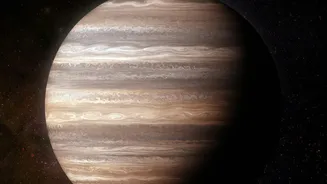
The size and mass of a planet play a crucial role in its ability to support life. If a planet is too small, its weak gravity won't be able to hold onto a substantial atmosphere, especially against the constant pressure of stellar winds. Recent models suggest a planet needs to have a radius of at least 80% that of Earth's to maintain its atmosphere over billions of years. Furthermore, a planet that is too small will cool down quickly, shutting down volcanic activity. While volcanoes can be destructive, they are vital for replenishing an atmosphere and cycling nutrients. On the other end of the scale, if a planet is too large—more than about twice Earth's radius—it tends to accumulate a thick, crushing atmosphere of hydrogen and helium, becoming a gas giant like Neptune rather than a rocky world with a surface.
Living with a Turbulent Star
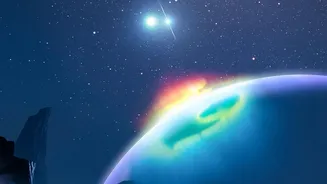
A planet could have the perfect size and a breathable atmosphere, but its fate is ultimately tied to the star it orbits. Stellar activity is a major factor in habitability. Many exoplanets are found orbiting red dwarf stars, which are smaller and cooler than our Sun. While this means their habitable zones are much closer to the star, it also exposes any orbiting planets to intense and frequent stellar flares. These powerful bursts of high-energy radiation can strip away a planet's atmosphere over time, boil off its water, and sterilize its surface. Even less frequent but more powerful flares from a Sun-like star can have a devastating impact. Therefore, a truly habitable planet needs a relatively stable star, one that provides consistent warmth without violent, life-ending tantrums. A planet's magnetic field, generated by a molten core, can offer crucial protection, but even that might not be enough against the most active stars.