


A Cosmic Sugar Cube
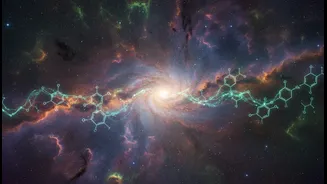
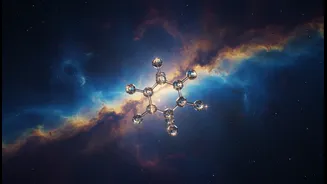
In a breakthrough for astrochemistry, researchers have detected a molecule of erythrulose, a true sugar, in a dense cloud of gas and dust near the center of our Milky Way galaxy. Unlike previous detections of sugar-like molecules on asteroids, this is the first
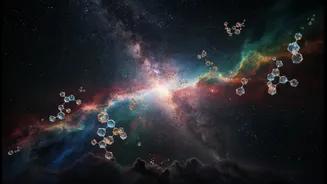
time a sugar has been found floating in the interstellar medium—the raw material from which stars and planets are born. Erythrulose is a four-carbon sugar, and on Earth, it's a compound found in fruits like raspberries. Its discovery in the molecular cloud G+0.693−0.027 suggests that the chemical factories of the cosmos are capable of producing more complex and life-critical molecules than previously confirmed.
How to Find a Molecule Light-Years Away
Spotting a specific molecule in a cosmic cloud trillions of kilometres away is a monumental task. A team from Spain's Centre for Astrobiology achieved this using highly sensitive radio telescopes. Every molecule, when energized, vibrates and rotates, emitting faint radio waves at a unique set of frequencies—a sort of molecular 'barcode'. The challenge was that a dense gas cloud emits a cacophony of signals from countless different molecules. The researchers used a recently developed technique to recreate the specific light signature of vaporized sugar in a lab. This allowed them to filter through the cosmic noise and find the 25 distinct spectral lines that perfectly matched the barcode for erythrulose, confirming its presence with certainty.
An Essential Ingredient for Life
The discovery of interstellar sugar is more than just a scientific curiosity; it touches upon the very origin of life. Sugars are fundamental building blocks for life as we know it. Specifically, they form the backbone of RNA (ribonucleic acid), a molecule many scientists believe was a precursor to DNA in the earliest forms of life on Earth. Finding erythrulose in a pre-stellar cloud means that these crucial ingredients could have existed long before Earth was even formed. It supports the idea that the essential components for life aren't unique to our planet but are widespread throughout the universe, cooking in giant cosmic kitchens.
Seeding the Planets
This finding lends significant weight to a hypothesis known as 'pseudo-panspermia'. While classic panspermia theorizes that actual microbes travel through space, pseudo-panspermia proposes that it's the non-living organic ingredients for life that are created in space and delivered to planets via comets and asteroids. This discovery shows that the interstellar medium can produce these ingredients. Scientists estimate that billions of years ago, vast quantities of this space-faring sugar could have been delivered to a young Earth by a constant bombardment of space rocks, potentially kick-starting the chemical reactions that led to life.