





The Age-Old Lecture Hall Dilemma
For generations, the core challenge of being a student has remained the same. You need to absorb complex information delivered at a pace of around 150 words per minute, while your own writing speed maxes out at about 30. This fundamental gap means something
always gets missed. You either capture fragmented quotes and lose the overarching concept, or you focus on the concept and fail to document the crucial supporting details. Studies have even shown that students who try to transcribe lectures verbatim often retain less information than those who summarize and process the content. This puts students in a difficult position: actively listen or create a detailed record? Until recently, you couldn't do both.
A New Era of On-Device AI
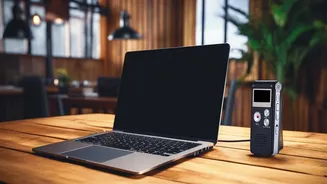
The latest wave of mobile artificial intelligence is changing this equation entirely. A new category of AI-powered note-taking applications can now run directly on your smartphone, using its internal processing power to provide real-time transcription and summarization. Crucially, these tools do not require an internet connection to function. This is a significant breakthrough because most earlier AI tools relied on sending your audio data to the cloud for processing, which was often impractical in large lecture halls or conference centres with notoriously poor Wi-Fi. Now, the entire process—from listening to the lecture via your phone's microphone to generating structured notes—can happen entirely on your device, ensuring privacy and accessibility anywhere.
How Does Offline AI Actually Work?
The magic behind these offline tools lies in the advanced processors built into modern smartphones, often called Neural Processing Units (NPUs). These chips are specifically designed to handle the complex calculations required by AI models efficiently. Instead of sending large audio files to a data centre, developers can now deploy highly optimized AI models, like versions of the 'Whisper' transcription model, directly within the app. When you record a lecture, the app uses the NPU to convert speech to text in real-time. It then applies another layer of generative AI to identify key concepts, define terms, and organize the raw transcript into a structured summary with headings and bullet points. Because none of your data ever leaves your device, it remains completely private.
The Key Benefits: Privacy, Speed, and Access
The advantages of on-device AI for note-taking are clear. First and foremost is accessibility; the ability to transcribe a lecture without needing Wi-Fi is a game-changer for students in less-than-ideal environments. Second is privacy. For sensitive meetings, research interviews, or personal thoughts, keeping your data local provides peace of mind that cloud-based services cannot guarantee. Finally, there is speed. With no upload or download times, the transcription and summarization can appear almost instantly, allowing you to review and even ask questions about the content moments after it was spoken. Some apps even allow you to generate flashcards, quizzes, and action items from the lecture content, transforming a passive recording into an active study tool.
What to Look for in an AI Note-Taker
As this technology becomes more common, choosing the right app depends on your specific needs. Look for tools that explicitly advertise 'on-device' or 'offline' processing. Check which languages they support for transcription and whether they offer features beyond simple transcription, such as identifying different speakers, creating summaries, or generating study materials. Some apps are designed as all-in-one solutions that can handle audio files, YouTube links, and even PDF documents, centralizing your study materials in one place. Be mindful of the business model; while some apps offer free tiers, many of the most powerful offline features may require a one-time purchase or a subscription.
The Future of Focused Learning
While this technology is incredibly powerful, it's not a replacement for paying attention. The true value of these tools is not to encourage you to zone out during a lecture, but to free you from the mechanical task of transcription. By offloading the burden of capturing every word, you can engage with the material on a deeper level—thinking critically about the arguments, formulating questions, and connecting ideas in real-time. The AI provides the perfect, detailed safety net. This shift allows students and professionals to move from being passive scribes to active participants in their own learning, ensuring that nothing gets missed while comprehension is maximized.