

A New Eye on the Cosmos
Scheduled to launch aboard a SpaceX Falcon Heavy rocket on August 30, 2026, the Nancy Grace Roman Space Telescope is NASA's next great observatory. While its mission also includes unraveling the mysteries of dark energy and dark matter, a huge part of its job
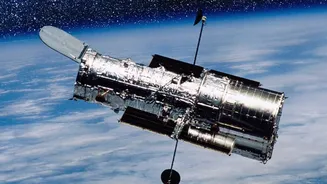
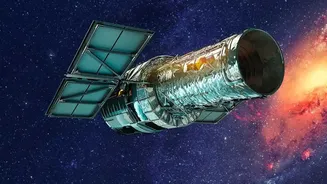
is to conduct a census of planets outside our solar system. Named after Nancy Grace Roman, NASA’s first chief of astronomy and the “Mother of Hubble,” this new telescope has a mirror the same size as the Hubble Space Telescope's—2.4 meters in diameter—but with a staggering difference: its field of view is over 100 times wider. This panoramic capability means Roman can image vast swathes of the sky with the same sharp resolution as Hubble, but in a fraction of the time. Where Hubble might capture a single galaxy, Roman will capture thousands. This ability to survey huge areas efficiently is key to its planet-hunting strategy.
Hunting with Gravity's Lens
While past missions like Kepler found thousands of planets using the 'transit' method—watching for the slight dimming of a star as a planet passes in front—Roman will primarily use a different, powerful technique called gravitational microlensing. This method is ideal for finding planets that are further from their stars, in orbits similar to those in our own solar system, which the transit method often misses. A microlensing event happens when a star and its planet pass almost directly in front of a much more distant star. The gravity of the closer star acts like a natural magnifying glass, bending and amplifying the light from the background star, causing a temporary spike in its brightness. If that star has a planet, the planet’s own gravity creates a second, smaller blip on the light curve. Roman will stare at the dense star fields in the center of our Milky Way, monitoring hundreds of millions of stars for these fleeting events. From its vantage point in space, free from Earth's atmospheric blur, it's expected to detect thousands of new worlds, including rocky planets and even 'rogue' planets that don't orbit a star at all.
Blocking Starlight to See a Planet
Beyond its microlensing survey, Roman is equipped with a groundbreaking piece of technology called a Coronagraph Instrument. This instrument is a technology demonstration designed to do something incredibly difficult: take direct pictures of exoplanets. Planets are billions of times fainter than the stars they orbit, and their light is usually lost in the star's overwhelming glare. A coronagraph works like putting your thumb up to block the sun, using a system of masks and mirrors to suppress the starlight. Roman's coronagraph is the most powerful ever sent to space, featuring self-flexing mirrors that actively compensate for tiny imperfections in the telescope's optics. This will allow it to detect planets 100 to 1,000 times fainter than what current space-based coronagraphs can see. While its main targets will be large, Jupiter-like planets, the technology it proves will be a crucial stepping stone for future missions, like the planned Habitable Worlds Observatory, which aims to directly image Earth-like planets.
A Partner to Webb and Hubble
Roman is not a replacement for telescopes like Hubble or the James Webb Space Telescope (JWST), but a powerful complement. Think of it this way: Roman is the wide-angle lens, perfect for conducting massive surveys and finding thousands of interesting targets across the sky. JWST, with its incredible sensitivity and ability to analyze atmospheres, is the zoom lens. Roman will identify where to look, and JWST can follow up for detailed studies of the most promising worlds. For instance, Roman is expected to find planets down to the mass of Mars, providing a statistical treasure trove about how common different types of planets are throughout the galaxy. This census will fill in crucial gaps in our knowledge, especially for planets in colder, outer orbits like Jupiter and Saturn. By combining its wide-field surveys with the deep dives of other observatories, Roman will help create the most complete picture of planetary systems yet.