






A Dream Decades in the Making
The journey to Pluto didn't begin at the launchpad in 2006. It began decades earlier in the minds of scientists who yearned to complete the initial reconnaissance of the classical solar system. In 1992, a JPL scientistisation called Clyde Tombaugh, Pluto's
discoverer, to ask for permission to visit his planet. "I told him he was welcome to it," Tombaugh recalled, acknowledging the immense challenge. Getting the mission off the ground was an odyssey in itself. The New Horizons proposal was selected by NASA in late 2001, but it faced significant budget hurdles. For years, engineers and scientists meticulously designed and built a craft—roughly the size of a grand piano—robust enough to survive a long, cold trip and smart enough to perform a complex series of observations automatically. This preparation phase was critical; everything about the flyby had to be pre-programmed, as the one-way radio signal time to Pluto would be four and a half hours, making real-time control impossible.
The Long, Lonely Voyage
On January 19, 2006, New Horizons launched from Cape Canaveral aboard a powerful Atlas V rocket, becoming the fastest spacecraft ever launched from Earth. To shorten its trip by three years, the probe executed a gravity assist maneuver around Jupiter in February 2007. This slingshot accelerated it to more than 80,000 km/h. For most of the next eight years, the spacecraft was in hibernation mode to preserve its systems, waking only for brief annual checkouts. This long cruise was a period of patient waiting for the mission team on Earth. They had to trust that the hardware they built years prior would function perfectly after a silent journey through the void. The navigation had to be flawless, aiming for a precise point in space where Pluto would be on a specific morning in July 2015. Everything in space is a moving target, and a mission like this had no room for error.
A Fleeting, Furious Encounter
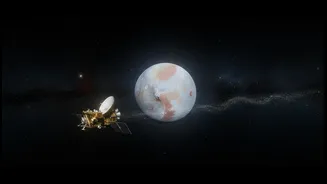
On July 14, 2015, after traveling for nine and a half years, New Horizons finally reached its destination. But it didn't stop. The probe was traveling too fast, and Pluto's gravity is too weak, to make entering orbit feasible without a prohibitively massive amount of fuel. The entire flyby, the culmination of decades of effort, was effectively over in a matter of hours. During this brief window, New Horizons was completely focused on science, turning its instruments toward Pluto and its moons, not its antenna toward Earth. It frantically collected data, filling its onboard recorders with high-resolution images and measurements. It passed just 12,500 kilometres from Pluto's surface, capturing details that transformed the dwarf planet from a blurry dot in our best telescopes into a complex, dynamic world.
A Treasure Trove of Discovery
Though the encounter was brief, the scientific payoff was immense and long-lasting. It took 16 months for New Horizons to send all 50-plus gigabits of its flyby data back to Earth, transmitting at a slow trickle across billions of kilometres. The final packet arrived in October 2016. What it revealed was stunning. Pluto wasn't the inert ball of ice some expected. Instead, the probe showed a geologically diverse world with vast, heart-shaped nitrogen glaciers (Sputnik Planitia), towering mountains made of water ice, and layers of atmospheric haze. The surface showed signs of recent geologic activity, including flowing ice, which surprised many researchers. The flyby also provided the first detailed look at Pluto's five moons, including its largest, Charon, which itself proved to be a complex world. Even years later, scientists are still making discoveries, like evidence of giant landslides, by re-examining the data from that brief 2015 pass.