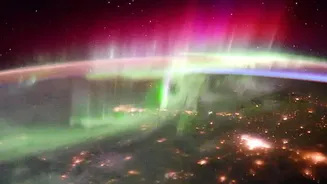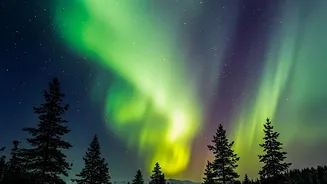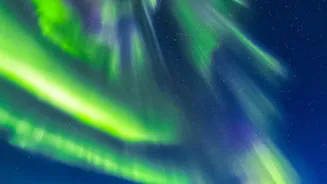



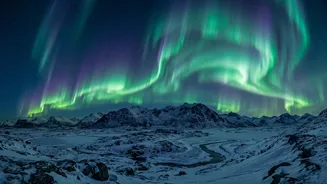
The aurora is one of nature's most dazzling displays, a silent dance of light in the polar skies. But new research reveals this beauty is just one part of a powerful process with tangible effects right here on Earth, happening faster than we knew.
The Symphony of a Substorm
The
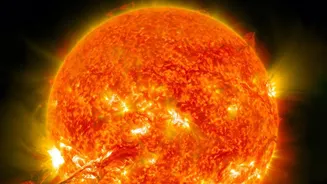
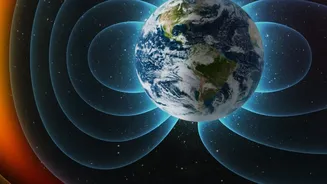
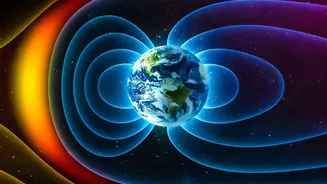
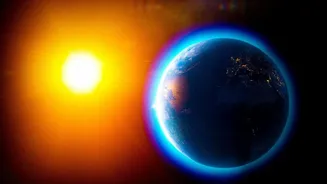
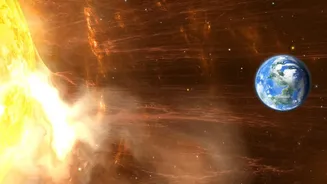
familiar glow of the aurora is the visible finale of a complex event called an auroral substorm. It begins when the solar wind, a constant stream of charged particles from the sun, interacts with Earth's magnetic shield, the magnetosphere. This interaction stretches the magnetic field lines on Earth's night side, storing immense energy like a pulled-back slingshot. A substorm is the explosive release of that stored energy. This happens tens of thousands of kilometres from Earth, shooting energetic particles along magnetic field lines toward the upper atmosphere. When these particles collide with oxygen and nitrogen, they create the vibrant, shifting curtains of light we call the aurora. A substorm is what causes a quiet auroral arc to suddenly brighten and dance across the entire sky.
A New Piece of the Puzzle
Scientists have long known that auroral substorms are linked to magnetic disturbances on the ground. The question has been about the timing and directness of this connection. Recent research, combining data from NASA satellites with ground-based instruments, has provided a clearer picture. The study shows that the effects of an energy release happening far out in the magnetosphere can reach Earth's surface in a matter of minutes. One observation showed a magnetic change at a spacecraft was followed just seven minutes later by a rapid change in the magnetic field on the ground. This is a much faster and more direct link than many previous models had accounted for, highlighting how quickly events in deep space can have consequences under our feet.
From Space to Soil: The Connection
The energetic particles that create the aurora also drive powerful electrical currents high up in the ionosphere. According to Faraday's law of induction, rapid changes in these atmospheric currents induce a secondary electric field at the Earth's surface. This ground-level electric field, in turn, can create what are known as geomagnetically induced currents (GICs). These are low-frequency currents that flow through any long, conductive networks on or in the ground. Essentially, the explosive energy of the substorm creates a magnetic ripple effect that travels from space to the atmosphere and finally induces real electrical currents on Earth. The new research demonstrates just how swiftly this entire chain reaction can unfold.
The Risk to Our Wired World
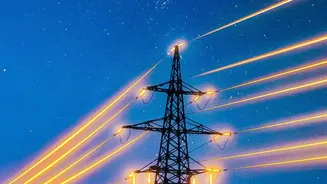
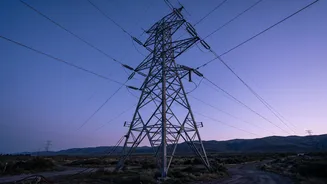
While they are invisible, geomagnetically induced currents are not harmless. These quasi-DC currents can flow into our electrical power grids, where they pose a significant threat to high-voltage transformers. The GICs can cause transformers to go into 'half-cycle saturation', leading to overheating, increased reactive power demand, and potential damage or failure. The most famous example of this was the March 1989 geomagnetic storm, which caused the collapse of the HydrostQuébec power grid, leaving millions in Canada without power for nine hours. Beyond power grids, GICs can also accelerate the corrosion of long metal pipelines and interfere with railway signalling systems. As our society becomes more reliant on interconnected technologies, understanding these risks is more critical than ever.