
An Ocean of Data from a Dusty World
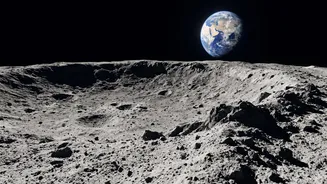
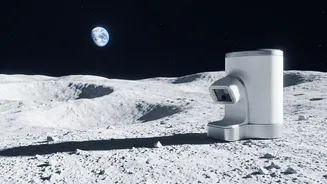
Returning to the Moon is about more than just planting a flag; it’s about establishing a sustainable human presence. To do that, scientists need detailed maps of the terrain, a clear understanding of the Moon's history, and, most importantly, the location
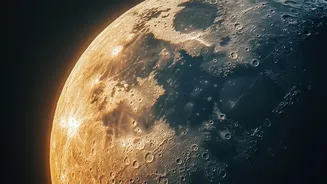
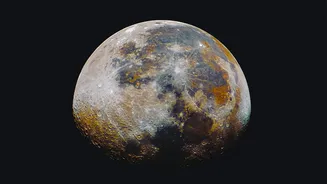
of resources like water ice. For decades, orbiters like NASA’s Lunar Reconnaissance Orbiter (LRO) have been gathering this information. The LRO mission alone has produced more data than all other NASA planetary missions combined, creating a high-resolution mosaic of nearly the entire lunar surface. The result is a petabyte-scale data challenge. Manually sifting through millions of images to find specific features like craters, lava tubes, or signs of ice is a monumental task, slowing down the critical work needed for the Artemis program.
Meet the NASA-IBM Lunar Foundation Model
To solve this problem, NASA has collaborated with IBM to launch the Lunar Foundation Model, a powerful new AI designed specifically for lunar science. Unlike previous AI tools that were built for a single, narrow task, this is a 'foundation model'. It has been pre-trained on a massive, diverse dataset, allowing it to understand the Moon's surface in a more holistic way. The model was trained on roughly 2 million image tiles from the LRO, combining high-resolution camera images with data from nine different scientific instruments across four separate missions. This allows the AI to see the Moon through multiple lenses at once, connecting visual data with topographical maps, temperature readings, and gravity measurements to spot patterns that would otherwise remain hidden.
The AI Geologist at Work
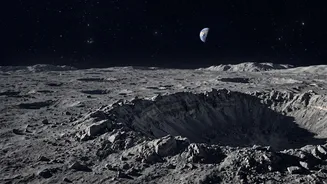
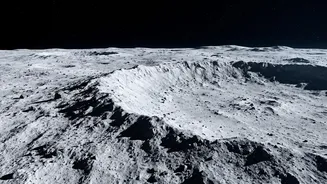
The AI's primary job is to accelerate discovery by automating the painstaking process of feature identification. Instead of scientists spending months searching for something specific, they can now use the model to do the heavy lifting. Its key tasks include mapping craters, spotting young volcanic features, and, crucially, estimating where water ice might exist in the Moon's permanently shadowed regions. Craters are essential for dating the lunar surface and for planning safe landing sites for future missions. The AI model has already demonstrated it can identify these features with up to 23% greater accuracy than previous methods. It can even distinguish a brand-new crater from an old one, a skill that was recently proven when it correctly identified the impact site from a SpaceX rocket. This capability transforms lunar mapping from a slow, manual effort into a rapid, automated process.
Unlocking the Secrets of Lunar Ice
Perhaps the most critical application for this new AI is the hunt for water ice. Ice is concentrated in permanently shadowed regions near the lunar poles, where temperatures are low enough to keep it frozen for billions of years. These areas are, by definition, pitch-black, making them incredibly difficult to study with traditional cameras. The AI model is designed to 'see in the dark' by analyzing faint, scattered light and cross-referencing it with temperature and terrain data to predict where ice is most likely to be stable, both on the surface and just below it. Finding accessible water is a primary goal for the Artemis program, as it can be converted into drinking water, breathable oxygen, and even rocket propellant, making long-term lunar habitation possible. By dramatically speeding up the search, the AI provides an invaluable tool for planning future robotic and human missions.
An Open-Source Tool for a New Era
One of the most significant aspects of the NASA-IBM Lunar Foundation Model is that it is open source. The entire codebase is publicly available, meaning scientists and researchers from around the world can use it, adapt it for their own specific questions, and build upon its capabilities. This collaborative approach aims to create a shared foundation for lunar science, preventing teams from having to build new AI models from scratch for every research project. This doesn't replace human scientists; it empowers them. By handing off the tedious task of data sifting to the AI, researchers can focus their expertise on interpreting the most promising findings and determining their implications for exploration. It marks a shift toward a human-AI partnership that will be essential for unlocking the Moon's secrets and paving the way for our return.