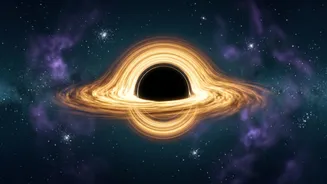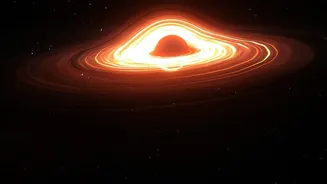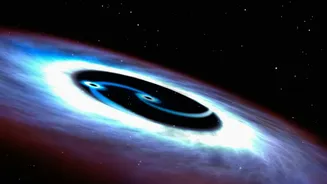






The Milky Way is thought to host 100 million black holes, yet we've found fewer than 100. Closing that gap feels impossible, but scientists have a secret weapon: thousands of volunteer 'Black Hole Hunters' using their eyes to find what AI can't.
The Needle in a Cosmic Haystack
Finding
a black hole is one of the universe's greatest challenges. They are the collapsed remnants of massive stars, so dense that not even light can escape their gravitational pull. This makes them effectively invisible. Astronomers typically find them when they are 'feeding' on a nearby star, a messy process that releases a blast of detectable X-rays. But what about the quiet, dormant black holes that aren't eating anything? Scientists theorize our galaxy is teeming with them, but they are incredibly difficult to spot. The search requires sifting through mountains of data from sky surveys that monitor the brightness of millions of stars over many years. This data deluge is far too vast for a small team of professional astronomers to analyze on their own.
A Magnifying Glass in Space
The Black Hole Hunters project, hosted on the Zooniverse citizen science platform, has a clever solution. Led by researchers from institutions like the University of Southampton, the project looks for a phenomenon predicted by Einstein's theory of general relativity: gravitational lensing. A black hole's immense gravity can bend and magnify the light from a star behind it, making the star appear to briefly and periodically brighten. When a black hole is orbiting a companion star, this effect, known as 'self-lensing', can create a repeating, characteristic spike in the star's brightness. This is the signature the volunteers are trained to find. By identifying these unique patterns in light-curve graphs, citizen scientists can flag potential binary systems where one partner is an invisible black hole.
How to Hunt a Black Hole from Home
Anyone with a computer or smartphone can become a black hole hunter; no prior experience in astronomy is needed. The process is designed to be simple and intuitive. Volunteers are shown graphs, or 'light curves', that plot a star's brightness over time. They are given examples of the specific symmetrical, sharp peak pattern that signifies a potential self-lensing event and are asked to identify whether the graph in front of them shows that signal. An artificial intelligence algorithm first does a preliminary sweep of the data, which comes from surveys like NASA's Transiting Exoplanet Survey Satellite (TESS), to filter out millions of obvious non-candidates. However, AI can be fooled by other cosmic events like stellar flares or instrument glitches. This is where the human eye excels, providing the crucial layer of pattern recognition needed to find the real deal.
The Power of the Crowd
The project's strength lies in the 'wisdom of the crowd'. Each light curve is shown to multiple volunteers. By combining their classifications, the system builds a consensus and reduces the chance of individual error. If enough people flag the same object, it gains a higher priority for professional astronomers to investigate further. This human-machine partnership is incredibly efficient. While an AI can process millions of stars in weeks, the volunteers' work provides the essential verification that saves precious and expensive telescope time. The classifications provided by thousands of volunteers also generate a massive training dataset that helps improve the machine learning models for future searches, creating a powerful feedback loop where humans and AI make each other smarter.
Early Success and Future Skies
Since it began, the Black Hole Hunters project has attracted tens of thousands of volunteers who have made millions of classifications. This collective effort is already yielding results. While the primary goal of finding the first confirmed self-lensing black hole is still being pursued, the project has identified several interesting candidates that astronomers are now following up on with powerful telescopes. An earlier phase of the project used data from the SuperWASP survey, and results from that search are expected to be published soon. The project demonstrates the immense potential of citizen science. It not only accelerates the pace of discovery but also democratizes it, allowing anyone with curiosity to participate in cutting edge research and potentially be the first person to discover a new type of cosmic object.