







The Coolest Spot in the Universe
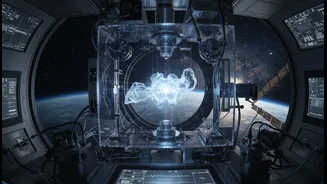
Aboard the International Space Station, a facility the size of a mini-fridge is home to the coldest known temperatures in the universe. NASA's Cold Atom Lab (CAL) is a quantum physics laboratory that uses lasers and magnetic fields to cool atoms like
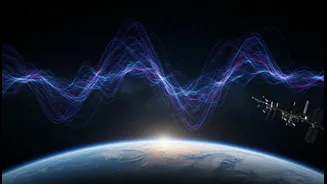
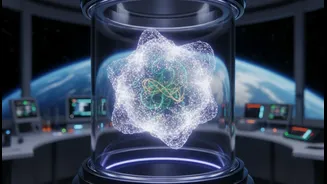
rubidium and potassium to just a fraction of a degree above absolute zero, or minus 273.15 degrees Celsius. At these extreme temperatures, atoms slow to a crawl and enter a bizarre fifth state of matter called a Bose-Einstein Condensate (BEC). In a BEC, the individual atoms lose their distinct identities and behave like a single, massive quantum wave. First created in orbit by CAL in 2018, this state of matter allows scientists to observe quantum phenomena, which are normally confined to the subatomic realm, on a macroscopic scale.
Why Space is the Ultimate Laboratory
While scientists can create BECs on Earth, gravity poses a major problem. The moment the traps holding the ultracold atoms are released for observation, gravity pulls the fragile condensate downwards, causing it to dissipate within milliseconds. This gives researchers a very short window to conduct experiments. In the microgravity environment of the ISS, however, the effects of gravity are almost nonexistent. This allows the condensates to float freely, remaining intact for much longer periods—stretching observation times from milliseconds to over a second. This extended freefall allows for more precise measurements and enables experiments that are simply not possible on Earth, such as the creation of ultracold atomic bubbles that would collapse under their own weight on the ground.
What We Have Gained So Far
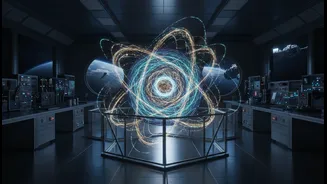
Since its installation, the Cold Atom Lab has been a game-changer for fundamental physics. It has successfully demonstrated the creation of dual-species quantum gases, which is a stepping stone to new experiments in quantum chemistry. One of its key tools is the atom interferometer, which uses the wave-like properties of atoms to measure forces like gravity with extreme precision. By operating these interferometers in space, scientists can perform more sensitive tests of Einstein's theories. Furthermore, the lab has enabled the study of how atoms behave in unique geometries, like hollow spheres, providing insights into superfluidity and other quantum phenomena without the interference of gravity. These advancements are not just theoretical; they are crucial for developing the next generation of quantum technologies, including ultra-precise sensors and navigation systems that don't rely on GPS.
What Still Needs Checking
The work at the Cold Atom Lab is far from over. With recent hardware upgrades in 2026 enhancing its capabilities, scientists are pushing into new frontiers. One of the major ongoing goals is to test one of the cornerstones of general relativity: the equivalence principle, which states that gravity affects all objects equally regardless of their mass. By simultaneously studying two different types of atoms (like rubidium and potassium) in a BEC as they fall, researchers can look for tiny deviations that might point to new physics. There are also plans to use the lab to investigate fundamental mysteries like dark matter and dark energy, and to explore the boundary between the quantum world and the macroscopic world governed by gravity. The facility is also being used to mature quantum technologies for space, paving the way for atom-based sensors that could map the gravity of the Moon or help astronauts navigate deep space.