



Bhubaneswar: The Temple City's Sacred Flavours
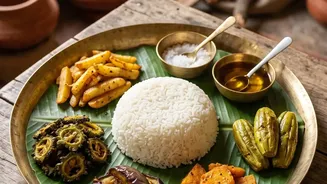
As you wander through the hundreds of temples in Bhubaneswar, from the grand Lingaraj to the serene Rajarani, the city's culinary identity makes itself known. The most profound experience is the 'Abhada' at Ananta Vasudeva Temple. Served on banana leaves,
this sacred meal consists of dishes like 'Ghia Anna' (rice with ghee), 'Dalma' (lentils with vegetables), and 'Kanika' (sweet, fragrant rice), all cooked in earthen pots without onion or garlic. It is a taste of devotion itself. For a more everyday flavour, the streets offer 'Gupchup' (Odisha's version of Pani Puri) and the iconic 'Dahi Bara Aloo Dum', a unique combination where lentil fritters are soaked in spiced yoghurt and served with a mild potato curry. Restaurants like Dalma and Odisha Hotel are famed for presenting authentic Odia thalis, providing a comprehensive introduction to the state's cuisine right in the capital.
Puri: Feasting on Faith and Fresh Catch
Puri, home to the revered Jagannath Temple, offers one of the most significant food experiences in India: the Mahaprasad. This offering to Lord Jagannath comprises 56 distinct items, known as 'Chhappan Bhog', cooked in the world's largest temple kitchen. Dishes like 'Khicede' (a local variant of khichdi) and sweets are part of this divine offering. Beyond the temple, Puri's coastal location means a bounty of fresh seafood. Stalls along Swargadwar Beach come alive in the evenings, selling crispy fried pomfret, prawn masala, and crab curry, marinated in local spices and served hot. Don't leave without trying 'Khaja', a layered, flaky pastry soaked in sugar syrup, which is another famous part of the Mahaprasad and a beloved local sweet.
Konark and the Sweet Journey
The magnificent Sun Temple at Konark is a testament to artistic genius. The journey to and from this UNESCO World Heritage site is a culinary corridor for sweets. The route between Bhubaneswar and Puri is dotted with vendors selling Odisha's signature dessert, 'Chhena Poda'. This is a 'burnt cheese' dessert, where fresh cottage cheese is sweetened, baked until a caramelised crust forms, and infused with a smoky aroma. Its accidental creation in the town of Nayagarh has become a symbol of Odia identity. Another unique sweet found near Konark, in the town of Nimapada, is the 'Chenna Jhili', a cottage cheese Jalebi that is soft, syrupy, and utterly delicious. These sweets are not just treats but represent a long-standing tradition of milk-based confectionery in the region.
Cuttack: The Silver City's Street Food Star
While Bhubaneswar is the capital, Cuttack is often called the culinary heart of Odisha, primarily for one dish: 'Dahibara Aloodum'. Though available across the state, Cuttack's version is legendary. Street vendors, some of whom have been in business for generations, serve soft lentil dumplings in a thin, tempered yoghurt water, topped with a spicy potato curry ('aloodum') and sometimes 'ghuguni' (pea curry). The combination is a burst of tangy, spicy, and savoury flavours that defines Odia street food culture. In fact, the dish is so beloved that it has its own dedicated day of celebration, 'Dahibara Aloodum Dibasa', on March 1st.
Pakhala Bhata: The Soul of Odia Summer
No culinary tour of Odisha is complete without experiencing 'Pakhala Bhata'. This isn't just a dish; it's a cherished cultural practice, especially during the hot summer months. It consists of cooked rice that is cooled and soaked in water, often left to ferment overnight. The resulting meal is light, cooling, and incredibly refreshing. It's typically served with an array of side dishes like 'Badi Chura' (crushed, sun-dried lentil dumplings), 'Saga Bhaja' (fried leafy greens), and fried fish. This humble dish is so integral to Odia life that it's celebrated annually on March 20th as Pakhala Dibasa (Pakhala Day) and is even offered to Lord Jagannath in Puri.