
What Did Scientists Discover?
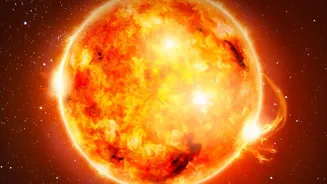
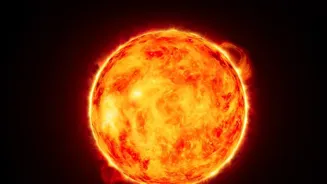
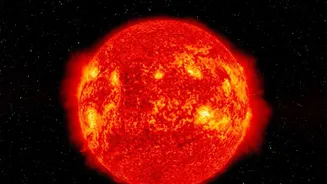
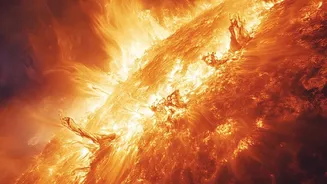
Researchers have observed tiny, previously unseen vortices of plasma swirling at the edges of solar granules—the bubbling, cell-like structures that cover the Sun's visible surface. These vortices, some as small as 20 kilometers wide, resemble cresting
ocean waves and are believed to be a sign of Kelvin-Helmholtz instabilities, a phenomenon that occurs when fluids or gases moving at different speeds flow past each other. This effect can be seen in clouds and ocean waves on Earth, but spotting it on the Sun required the immense power of the Daniel K. Inouye Solar Telescope in Hawaii. These mini-whirlpools are constantly forming and are thought to play a crucial role in how the Sun’s magnetic field behaves. The achievement is a massive leap in observational power, likened to seeing the details on a coin from over 100 kilometers away.
Unlocking the Sun's Magnetic Engine
So, why are these tiny swirls so important? Scientists believe they offer a new perspective on how the Sun stores and violently releases energy. The Sun's magnetic field lines are thought to twist and coil like a spring, building up immense energy that can suddenly be released in events like solar flares. A long-standing question has been what drives this constant twisting. These newly discovered vortices, which occur constantly where the magnetic field is strong, could be the driving force. By physically bending and deforming the magnetic field at the surface, they may be the missing link that helps explain the Sun's exceptionally rapid 11-year activity cycle. For years, theories suggested the sun's magnetic activity originated deep within its interior, but recent findings point to it being generated much closer to the surface, potentially within 20,000 miles below. These vortices support the idea that crucial processes happen right at the visible surface.
A New Window into Solar Mysteries
The discovery does more than just explain magnetic twisting; it could also solve other major solar puzzles. One is the 'coronal heating problem'—the baffling fact that the Sun's outer atmosphere, the corona, is millions of degrees hotter than its surface. The energy from these swirling vortices could be a key mechanism for transferring energy from the surface into the corona, helping to heat it to such extreme temperatures. Furthermore, the vortices appear to efficiently mix magnetized and non-magnetized plasma. This could explain how the Sun's magnetic field spreads so quickly from its surface into its atmosphere, a process that existing models have struggled to account for. By combining these ultra-high-resolution observations with sophisticated computer simulations, scientists can now verify physical theories in unprecedented detail.
Why It Matters for Us on Earth
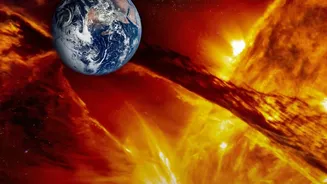
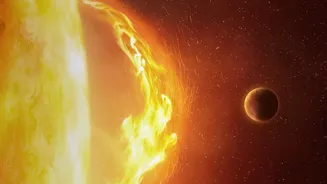
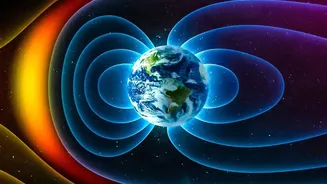
Understanding the Sun isn't just an academic exercise; it has very real-world implications. The Sun drives space weather—the stream of charged particles and massive eruptions like coronal mass ejections (CMEs) that flow through our solar system. When directed at Earth, these solar storms can disrupt our planet's magnetic field, potentially damaging satellites, knocking out power grids, and interfering with GPS and communication systems. A better understanding of the fundamental physics driving solar activity is crucial for improving our ability to predict these events. By observing the 'motors' of magnetic energy, like these newly found vortices, scientists hope to develop more accurate and timely space weather forecasts, giving us more time to prepare for and mitigate the impacts of a major solar storm.