

Why We Need Infrared Vision
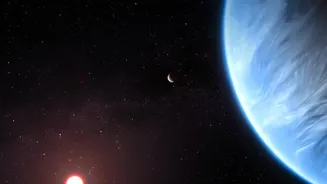
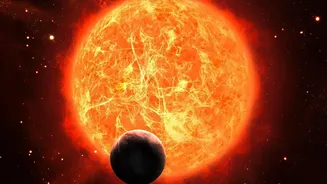
When we look for exoplanets, we face a major challenge: they are incredibly faint and lost in the brilliant glare of their parent stars. While they don’t produce their own visible light, they do get hot. Like a hot engine or a toaster element, these planets glow
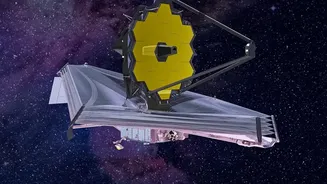
with heat, which is emitted as infrared light. This makes infrared telescopes, like the powerful James Webb Space Telescope (JWST), essential tools. They can peer through cosmic dust and detect this faint heat signature, allowing scientists not just to find planets, but to begin to understand what they are like. By observing in the infrared spectrum, we can see what is invisible to the human eye, turning these distant dots of light into worlds we can study in detail.
Reading the Barcode of an Atmosphere
One of the most powerful techniques for studying an exoplanet’s air is called transit spectroscopy. It works when a planet passes, or “transits,” in front of its star from our point of view. As starlight filters through the edge of the planet's atmosphere, gases in that atmosphere absorb very specific wavelengths, or colors, of light. This leaves a unique pattern of missing light, like a chemical barcode, in the star's spectrum. By analyzing this barcode, scientists can identify the molecules present, such as water vapor, carbon dioxide, methane, and even sulfur dioxide. This fundamental technique is how we get our first detailed list of atmospheric ingredients from light-years away.
Catching the Wind with a Shift in Light
Mapping wind on a planet hundreds of light-years away sounds impossible, but scientists do it using the Doppler effect. It’s the same principle that makes an ambulance siren sound higher-pitched as it approaches and lower as it moves away. Light behaves similarly: light from an object moving toward us shifts to the blue end of the spectrum, and light from an object moving away shifts to the red. As an exoplanet rotates, one side of its atmosphere moves toward us and the other moves away. By precisely measuring the tiny Doppler shifts in the atmospheric 'barcode' on either side of the planet, astronomers can calculate the speed and direction of its winds. This allows them to create maps of atmospheric circulation, revealing everything from gentle breezes to planet-circling jet streams.
How to See Rain You Can't Touch
Detecting rain, especially when it's made of something like iron, requires some clever detective work. Take the famous exoplanet WASP-76b, a gas giant so hot its day side reaches temperatures over 2,400°C. At these temperatures, metals like iron vaporize into a gas. Using transit spectroscopy, scientists detected this gaseous iron on the planet's scorching-hot day side. However, when they looked at the cooler 'evening' boundary, where the day side transitions to the night side, the iron signature was gone. The conclusion is that the planet's powerful winds carry the iron vapor to the cooler night side, where it condenses into liquid droplets and falls as molten iron rain. So while we don't 'see' the drops, we see the chemical evidence of a substance being present as a gas in one place and then disappearing as it cools, strongly implying it rained out of the atmosphere.
A New Era of Exoplanet Weather Reporting
The launch of the James Webb Space Telescope has revolutionized this field. With its unparalleled sensitivity in the infrared spectrum, JWST can capture atmospheric data with astonishing detail and clarity. It has already provided a full chemical and molecular profile for planets like WASP-39 b and found the strongest evidence yet for an atmosphere around a rocky exoplanet. Before, we could detect maybe one or two elements. Now, telescopes like JWST allow scientists to create a whole menu of atmospheric ingredients, identify signs of active chemistry, and map cloud structures. This technology is turning exoplanets from abstract points of data into complex, dynamic worlds with their own unique and often extreme weather, bringing us closer than ever to understanding the diversity of planets in our galaxy.