



Our Only Working Model
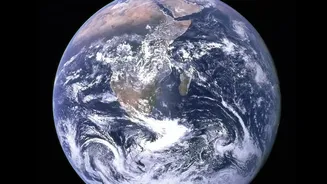
The fundamental reason scientists study Earth is simple: it’s our only confirmed example of a planet teeming with life. Understanding planetary habitability is, for now, an extrapolation of the conditions we find here. We know life can exist with our specific
mix of water, carbon, and a protective magnetic field, all within a certain distance from our star. This makes Earth the ultimate template. By studying its processes—from plate tectonics to atmospheric composition—researchers can identify the key factors that might support life elsewhere. When telescopes like the James Webb Space Telescope peer at distant exoplanets, they are looking for worlds that rhyme with our own, using Earth as the benchmark for what a living planet looks like from afar.
A Journey Through Alien Earths
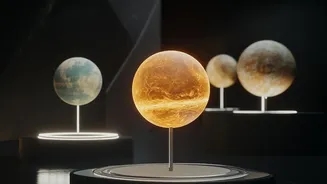
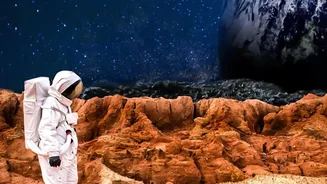
Studying Earth isn’t just about observing it today; it’s also about looking into its deep past. Over its 4.5 billion-year history, Earth has been many different kinds of planets. It has gone from a world with a toxic, oxygen-free atmosphere to an ice-covered 'snowball', and then to the green and blue marble we know. Each of these ancient versions of Earth provides a different model for what a habitable, or potentially habitable, planet could look like at various stages of its evolution. Researchers model these past environments to create spectral templates, helping them recognise a young, microbial-era planet versus one with widespread vegetation. This means we're not just looking for an exact copy of modern Earth, but for any of the 'alien' Earths that have existed through geologic time.
Life on the Edge
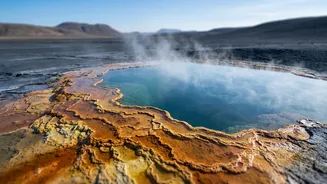
For a long time, the search for life was limited by our understanding of where it could survive. That changed with the discovery of extremophiles: organisms on Earth that thrive in conditions we once thought were inhospitable. They exist in boiling hot springs, acidic waters, the crushing pressure of the deep sea, and even frozen inside Antarctic ice. The existence of these hardy microbes radically expands the definition of a 'habitable zone'. It tells scientists that life doesn't need a perfect paradise to take hold. This knowledge encourages researchers to consider a wider range of extraterrestrial locations, like the subsurface oceans of icy moons like Europa and Enceladus, as potential homes for life.
Searching for Cosmic Fingerprints
When scientists examine an exoplanet's atmosphere, they are looking for biosignatures—gases or chemical combinations that indicate the presence of life. Earth is our primary laboratory for understanding these signs. For example, the simultaneous presence of oxygen and methane in our atmosphere is a strong indicator of life, as these gases would normally destroy each other without being constantly replenished by biological processes. Scientists also study how vegetation reflects light, creating a 'red edge' signature that could be spotted on other worlds. By cataloging all the ways life has altered our planet's chemistry and appearance, we learn what to look for dozens or hundreds of light-years away.
The Hunt for Technology
Beyond simple life, some scientists are searching for technosignatures—evidence of advanced alien technology. Here too, Earth serves as a reference. We can study our own technological footprint, from radio signals leaking into space to industrial pollutants in the atmosphere like chlorofluorocarbons (CFCs), to guess what a developed civilisation on another planet might produce. While biosignatures point to any life, technosignatures would be proof of intelligent, tool-building life. This branch of study, an extension of the Search for Extraterrestrial Intelligence (SETI), uses our own journey as an industrialised species as one possible model for what to find.