






A New Shape on the Ringed Planet
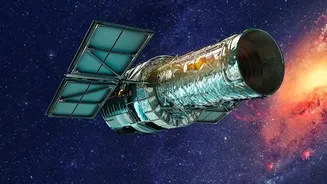
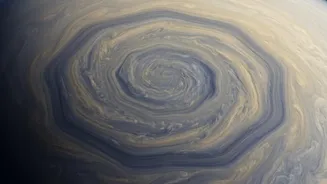
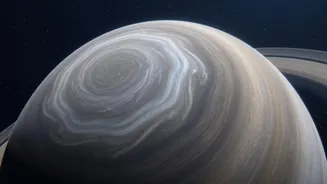
For decades, Saturn's most famous atmospheric feature was the bizarre, six-sided jet stream at its north pole, known simply as 'the Hexagon'. But recent observations from the Hubble Space Telescope have revealed a new geometric wonder: a ten-sided pattern,
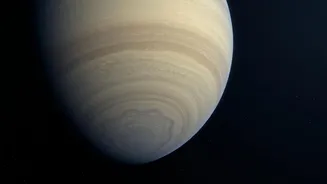
or decagon, emerging around the planet's south pole. This is the first time such a large, regular-sided pattern has been seen in Saturn's southern hemisphere, giving the planet a surprising counterpart to its long-observed northern mystery. Scientists, who had been searching for a southern equivalent to the hexagon for years without success, were stunned by the discovery.
An Evolving Weather Pattern
Unlike the northern hexagon, which has been a stable feature for at least 40 years, the southern decagon appears to be a recent development. Researchers using Hubble's Outer Planet Atmospheres Legacy (OPAL) program traced its origins, finding faint hints of the structure in images from 2023 before it became much more distinct in subsequent years. This gives scientists a rare and precious opportunity to watch a massive planetary weather system take shape in near real-time. The Cassini spacecraft, which orbited Saturn from 2004 to 2017, saw no signs of this long-lived formation, suggesting the decagon formed sometime after the mission's end.
The Science Behind the Sides
So, what could cause a jet stream to form a ten-sided shape? While the exact mechanism for the new decagon is still under investigation, the physics is likely related to what drives the northern hexagon. These shapes are believed to be standing waves in the atmosphere. Laboratory experiments have shown that when a circular tank of liquid is rotated at different speeds at its center and periphery, the turbulence between the fluid bodies can create stable polygonal shapes. On Saturn, steep changes in wind speeds at specific latitudes are thought to create these immense, persistent patterns. The southern decagon appears to be an atmospheric wave within a powerful jet stream, with winds whipping around at speeds of about 400 kilometers per hour.
More Than Just a Cloud Pattern
This isn't just a superficial pattern painted on the cloud tops. Observations at different wavelengths of light reveal that the decagon is a deep, towering structure that extends vertically through multiple layers of Saturn's atmosphere. Its apparent position shifts slightly depending on the altitude being observed, confirming it as a three-dimensional feature. While the northern hexagon is a deep-rooted and stable part of the planet's weather system, the new southern decagon seems more dynamic, with its vertices appearing to shift over a cycle of about 32 days. This suggests it may be a meandering wave rather than a rigid structure.
Two Poles, Two Puzzles
The discovery of a decagon raises fascinating questions. Why ten sides instead of six? And why did it form now? Saturn's two poles behave very differently; the south pole never had a hexagon when observed by Cassini. The emergence of the decagon suggests a fundamental asymmetry between the poles that we are only just beginning to understand. It could be a temporary feature, or it could be settling into a stable pattern that will last for decades, just like its northern sibling. Continued observation with telescopes like Hubble and the James Webb Space Telescope will be crucial to unlocking the secrets of how and why these incredible geometric storms form on other worlds.