




A Sweet Discovery Near the Galactic Centre
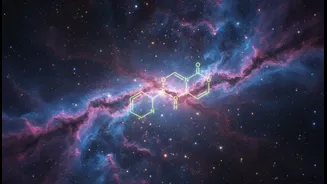
In a landmark finding, an international team of astronomers has detected a sugar molecule called erythrulose in a vast molecular cloud known as G+0.693-0.027, located roughly 27,000 light-years away near the centre of our Milky Way galaxy. Using powerful
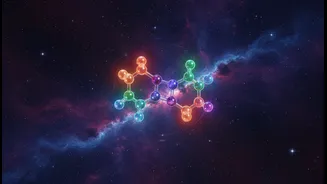
radio telescopes in Spain, researchers identified the unique rotational 'fingerprint' of this molecule in the faint light emitted from the frigid dust and gas. While simpler organic molecules have been found in space before, this marks the first time a true sugar has been directly detected in the interstellar medium, the raw material from which stars and planets are born. This isn't the sugar you put in your tea, but its presence so far from Earth has profound implications for one of science's biggest questions: how did life begin?
Why This Sugar Is a Big Deal
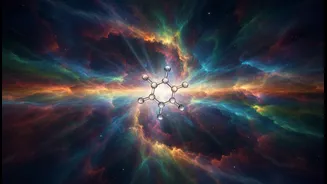
Sugars, or saccharides, are fundamental to life as we know it. They serve as energy sources for cells and, most importantly, form the structural backbone of RNA and DNA. Scientists have previously found sugars like ribose on meteorites that have landed on Earth, suggesting these vital ingredients could have come from space. However, finding erythrulose freely floating in a star-forming cloud is a major leap. Erythrulose is a four-carbon sugar, making it significantly more complex than the two-carbon sugar-like molecules found before. Its detection confirms that the chemical processes in these interstellar nurseries can create molecules that are direct precursors to the building blocks of life. In the right aqueous conditions, erythrulose can be converted into other sugars that are thought to be evolutionary predecessors to ribose, the sugar at the heart of RNA.
The Cosmic Recipe for Life's Ingredients
One of the most surprising aspects of the discovery is how the erythrulose seems to have formed. Researchers found it to be much more abundant than any simpler three-carbon sugars, which were conspicuously absent. This challenges the idea that complex molecules form one carbon atom at a time. Instead, models suggest that erythrulose forms efficiently on the icy surfaces of cosmic dust grains. In these stellar nurseries, simpler two-carbon molecules like glycolaldehyde and ethylene glycol can combine to create the more complex four-carbon sugar. This suggests that the universe has a way of fast-tracking the production of key prebiotic molecules, creating them in the very regions where new planetary systems are taking shape.
From Stardust to Our Planet
So, how does a sugar molecule 27,000 light-years away matter to us? The discovery provides strong support for the theory of panspermia, the idea that life on Earth may have been seeded with ingredients from space. During the early formation of our solar system, a period known as the Late Heavy Bombardment saw Earth being constantly pelted by comets and asteroids. These cosmic deliveries could have brought vast quantities of complex organic molecules, including sugars like erythrulose, to the young planet. Researchers estimate millions of tonnes of erythrulose could have arrived this way, providing a rich inventory of raw materials for the first metabolic and genetic processes to emerge from the primordial soup. This doesn't mean life itself arrived from space, but that the essential building blocks were readily available.